 Coin Price Analysis
LEO would need to gain about 42% from its November 23, 2026 UTC close of $9.17 to reach $13. That would imply close to $12 billion in value at a rounded 920 million token base. The case depends on what holders actually use LEO for, how much of the repurchase policy turns into completed transactions and how readily the token trades at the required size. CoinGecko LEO historical data
Test the utility that remains after zero trading fees
Bitfinex’s zero-fee policy ended the trading-fee discount linked to holding LEO for the eligible products it describes. Its FAQ distinguishes that expired benefit from ongoing benefits such as certain deposit or withdrawal discounts, a limited number of fee-free fiat withdrawals depending on holdings, and affiliate rebate multipliers. If a guide still values LEO by multiplying its old maker or taker discount by a trading balance, replace the input with the current policy for the product and account. Bitfinex zero-fee FAQ
A practical test is to calculate your avoided fee on the activity that actually qualifies and compare it with the costs of buying, holding and later selling the required amount. The benefit could be meaningful for an account that regularly uses an eligible withdrawal. Another trader might receive little from the same holding. Market demand cannot be inferred from the number of people eligible for zero trading fees because LEO is not required for that particular pricing feature.
Check the repurchase base and the final burn
The 2019 whitepaper specified monthly repurchases with a minimum value tied to 27% of the previous month’s consolidated gross iFinex revenues, excluding Ethfinex, under the cited terms. Bitfinex’s later FAQ says that the change to zero trading fees leaves the buyback and burn framework unchanged because it is based on broader revenues. The share specifies a policy, not the dollar amount of monthly purchases. To estimate actual impact, identify the applicable revenue base and confirm what happened in the market and on-chain. iFinex whitepaper · Bitfinex policy FAQ
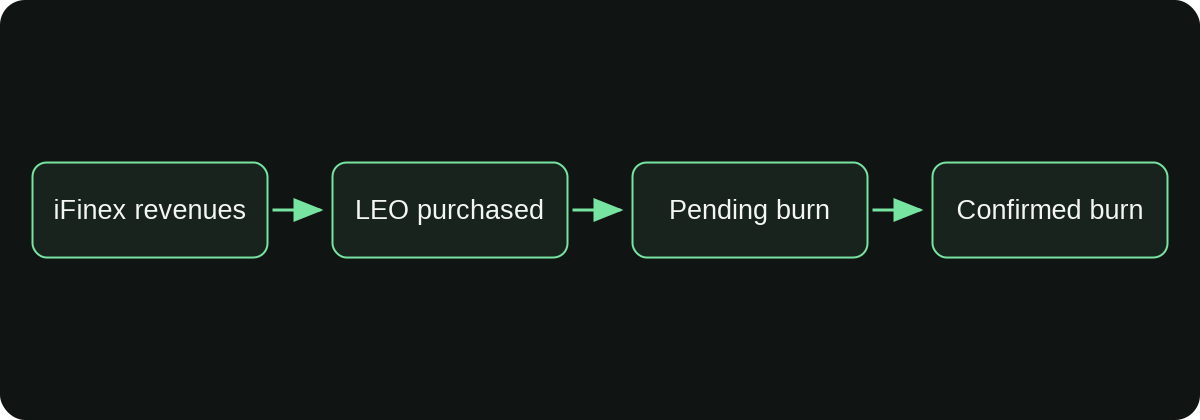
Bitfinex’s transparency interface lists supply, burned tokens, amounts pending burn and acquisitions. If you are writing a monthly update, save comparable snapshots and follow transaction references where available. A pending balance should not be subtracted again if it has already been included in a different category of your supply model. Likewise, an isolated month of substantial buybacks can be funded by a revenue mix that is unlikely to persist. Use enough periods to distinguish an ongoing pattern from one large purchase. Bitfinex LEO transparency dashboard
A narrow price range can hide a costly exit
| LEO 2027 stress level | From $9.17 | Implied value at 920M LEO |
|---|---|---|
| $7 | −24% | $6.44 billion |
| $10 | +9% | $9.20 billion |
| $13 | +42% | $11.96 billion |
At the cited cutoff, CoinGecko’s November 23 row listed about $644,000 in its volume field even though the reported market value was in the billions. Those statistics serve distinct purposes. Aggregate turnover cannot establish how much can be sold on an accessible venue. Check a quoted bid at the amount you actually want and confirm conversion and withdrawal costs. A quiet chart can reflect trades in a relatively thin market. CoinGecko LEO historical data
The $7 case tests reduced utility or weaker accessible liquidity. $10 tests a modest recovery within the current framework. To justify $13, look for persistent token-specific use, independently observable reductions in supply and reliable depth across the relevant routes. The price points illustrate valuation scale. They carry no odds and an outcome outside the range is possible.
Compare three different sources of token demand
For a useful quarterly review, keep an eligibility record, a repurchase record and a liquidity record. The eligibility record states which remaining benefits an account can use and the balance required. The repurchase record states the applicable formula and documents any transactions actually completed. The liquidity record states which pair, size and exchange the holder can use. A change in one record can leave the others unchanged. For example, a new account perk may need a long holding period and have little immediate effect on depth.
Look at dollar amounts and token amounts separately. If iFinex spent the same amount in two months at different prices, the number of LEO acquired could differ. If the dashboard consolidates several burn transactions, do not infer dates or purchase prices from the aggregate alone. Use its cumulative ledger to reconcile the units and any chain split. Keep a market timeline for approved changes to benefits so old summaries cannot alter the baseline of your calculation. Bitfinex LEO dashboard
The executable-depth check matters even for a holder who plans to use a benefit over several years. Record the cost of entering and leaving the position at equivalent sizes. A fee saving is most meaningful when compared with spread, fees and the risk of a lower price. This is a practical comparison exercise rather than a prediction based on a contractual discount.
For any claimed net supply decline, look for a starting balance and an ending balance from the same source with comparable definitions. An Ethereum balance and the equivalent token record on another network may need to be reconciled before being added or subtracted.
Frequently asked questions
Do I earn iFinex revenue when I hold LEO? The repurchase commitment and account benefits have documented conditions. They are different from a cash distribution paid to every holder.
Can a completed buyback move the price before tokens are burned? A purchase can affect market liquidity when executed. The permanent supply effect has to be recorded separately when removal occurs.
Can a decline in LEO balances on one network prove that total supply fell? A change can reflect transfers or other accounting movements. Reconcile the network balances and check evidence of permanent removal.