 Coin Price Analysis
JST would need a gain of about 23% from its November 23, 2026 UTC close of $0.146452 to reach $0.18. JustLend reported burning more than 170 million JST in its fifth round, but the stronger evidence for 2027 is how much repeatable net lending income becomes an executed buyback and burn. A change in total deposits cannot answer that question by itself. CoinGecko JST price history · JustLend fifth-round notice
Start with the fifth buyback and burn
JustLend dates the fifth round to October 16, 2026 Singapore time. It reported 170,723,144 JST burned in the round, bringing its stated cumulative amount to 1,881,973,007 JST as of that day. Its notice also disclosed $9,280,216 in Q3 JustLend DAO net income and estimated the burned tokens were worth about $23.53 million at burn time. Those amounts measure different things. Dividing the value of the burn by the quarterly net income cannot show what percentage of that quarter’s earnings financed the purchases. JustLend’s October 17 completion notice
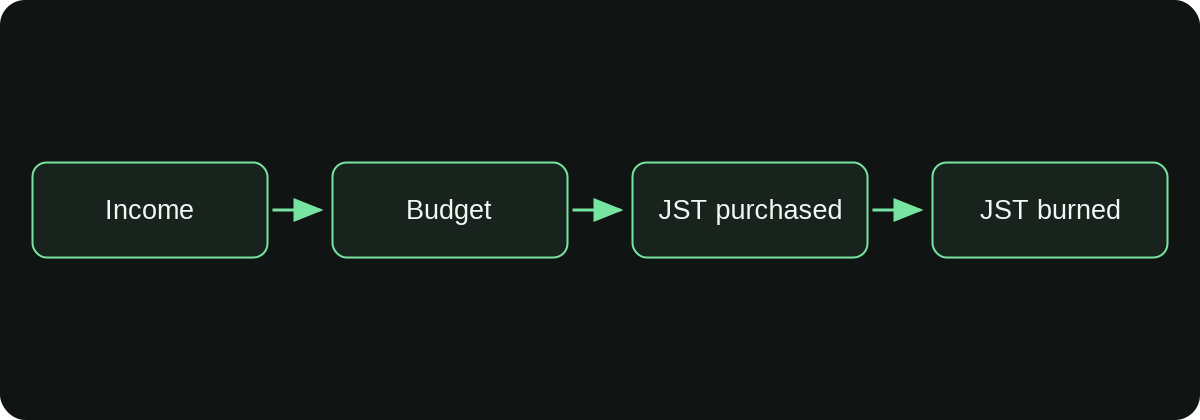
A practical ledger has four entries: the period in which income accrued, the funds approved for a buyback, the amount actually spent, and the token quantity finally burned. Each has a date. If a protocol is spending funds collected across several periods, note the funding origin rather than attributing the full amount to the latest quarter. For a supply calculation, check the date of the circulation estimate before deducting the burn. A provider may already account for the reduction.
What changed on November 23
JustLend said the USD1 and wstUSDT markets entered an orderly offboarding process and that supply and borrowing were disabled in those markets. The action applied to named lending markets, rather than every asset on TRON. Check their share of actual borrowing income before projecting an effect on JST. A market with large supplied balances can have low utilization, while a smaller market with active borrowing may contribute more to earnings. JustLend November 23 market notice
For a fair comparison, use figures for the same market and dates. Record outstanding loans, asset-specific utilization, income retained by the protocol and any incentive expenses. If conditions change after a lending market closes, watch whether borrowing reappears in another product. An announcement shows the parameters have changed. The weeks afterwards show whether the borrower demand migrated. TRON outlook for the broader network
What $0.09, $0.18 and $0.26 would mean
The protocol’s tokenomics documentation lists a 9.9 billion JST maximum supply. The illustrative table uses 8 billion circulating, about the scale of the capped amount after the stated cumulative burns. The estimate is intentionally rounded. Check current circulation rather than treating the original maximum or this calculation as a live reading. JustLend JST tokenomics
| JST price scenario | Move from $0.146452 | Implied value at 8B JST |
|---|---|---|
| $0.09 | −39% | $720 million |
| $0.18 | +23% | $1.44 billion |
| $0.26 | +78% | $2.08 billion |
The $0.18 case would be easier to support if utilization or retained income holds up and there are dated records of executed purchases. At $0.26 the valuation is materially larger. Check whether future demand justifies the scale and whether the liquidity available to sellers is growing. The lower case tests outcomes such as declining borrower demand, higher incentive costs or weaker governance-token liquidity. No level is a forecast boundary.
One way to challenge your assumption is to hold the same market value constant and update the supply inputs after the next burn. Then separately hold the supply fixed and vary the market value. This lets you see whether your model depends on a large repricing or a supply effect. For example, a 2% reduction in an assumed float changes the unit price by about 2.04% at constant value. That comparison does not predict how a market will respond to news.
The same method helps judge a change in reported utilization. Compare the balance of loans with the available underlying liquidity and note which definition the dashboard uses. An increase in utilization can come from more borrowing, less available liquidity, or both. The forecast implication changes with the cause. Write down whether the change appears in the market where borrowers pay the fees counted by the protocol.
Another useful cross-check is to calculate the number of JST removed relative to an earlier circulating estimate, then calculate it again relative to the original cap. These are legitimate but distinct ratios. The fifth round’s 170.7 million represented about 1.72% of the original 9.9 billion denominator. If you are updating a circulating valuation, use a compatible dated base instead. Label all denominator choices so that a later comparison does not apply a headline ratio to the wrong amount.
For evidence of repeat purchases, look for several quarters with comparable disclosures. If one transaction includes tokens acquired earlier, separate the purchasing period from the removal date. A purchase and a burn can occur months apart, and they answer different supply and market-liquidity questions. When only a completion statement is available, report the issuer’s stated amount and avoid inferring average execution price or order timing.
Frequently asked questions
Is the reported value of a burn the amount buyers paid for JST? The two values can differ. The purchase occurred at execution prices, whereas the published burn value can use a quote when the tokens were removed.
Does staking or delegating JST make those tokens permanently unavailable? The underlying rules determine when tokens can be withdrawn or transferred. Delegation, lockups and permanent removal each need a separate supply treatment.
Why can borrow income fall even if interest rates rise? Revenue depends on the balances paying those rates as well as the rates themselves. If borrowing contracts enough, a higher rate on the remaining borrowers can still generate less income.