 Coin Price Analysis
TRX would need to gain about 61% from its November 23, 2026 UTC close of $0.309737 to reach $0.50. That case is stronger if recurring stablecoin use creates measurable demand for TRX through staking or fee burns. The total value of USDT moved on TRON cannot establish either effect on its own. CoinGecko TRX price history · TRON’s resource model
Start with a single USDT transfer
A TRC-20 transfer consumes network resources. TRON describes Bandwidth in terms of transaction size and Energy in terms of smart contract execution. Resources can come from staking or delegation where applicable. When an account lacks adequate resources, the protocol can burn TRX under the network’s rules. This means a transfer can show paid activity while the sender burns little TRX, for example where another participant has delegated resources. TRON’s Bandwidth and Energy guide · TRON’s resource payment rules
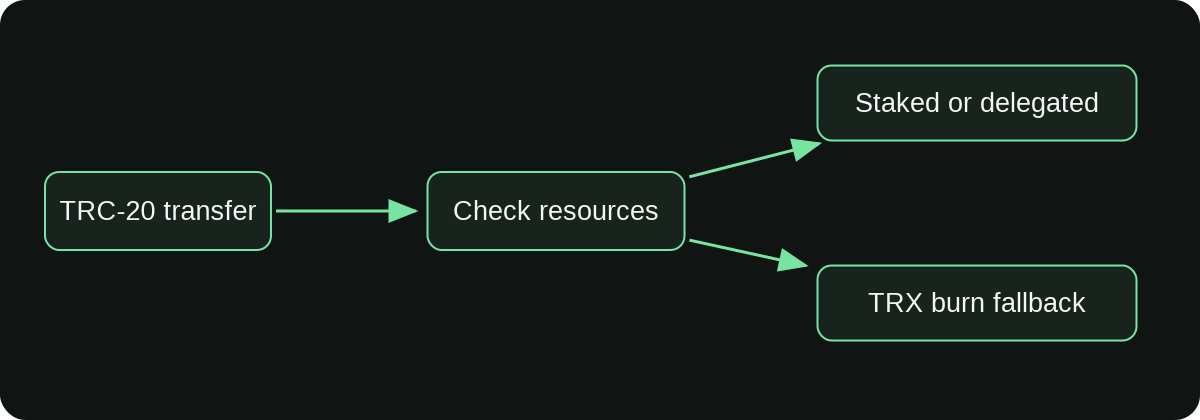
For forecasting, keep two columns from the start. The first records staked or delegated resources used, which can reflect an ongoing need to maintain access. The other records fees resulting in actual burns. Staked tokens can return to liquid use under the network’s rules. Burned units leave the relevant supply count. Treating every transaction as a burn would overstate reductions even when the transaction count is correct.
Put the November announcements in the right categories
TRON DAO’s November 2 release cited Token Terminal’s report of $2.18 trillion in Q3 stablecoin transfer volume. Its November 19 release announced that Pulsar added USDT deposits on TRON. The first measures gross transfers under the research provider’s definition. The second adds a way for users to fund a specific service. Check the same dataset and time window after the integration before claiming it has produced new customers or fee demand. TRON DAO’s Q3 report release · Pulsar TRC-20 deposit announcement
Dollar volume is useful for measuring value moved. It can grow because a few transactions became larger. A transaction count can grow because one service splits movements into smaller batches. Neither shows the number of people using the network. Fee demand is more convincingly measured by checking actual resources consumed and who funds them. If a payments company sponsors costs, its token needs may differ from those of each customer.
What the price cases imply at 94 billion TRX
| TRX year-end sensitivity | Move from $0.309737 | Implied value at 94B TRX |
|---|---|---|
| $0.23 | −26% | $21.62 billion |
| $0.36 | +16% | $33.84 billion |
| $0.50 | +61% | $47.00 billion |
The 94 billion figure is a rounded valuation input near the recent circulating scale. Actual issuance and burns change the amount. The $0.36 case is compatible with continuing use and modest demand growth. The $0.50 case would call for more durable evidence that greater use affects token demand, alongside market liquidity. The $0.23 case covers shifts in settlement routes, weaker access or lower willingness to hold TRX. Prices can move beyond any of the illustrated levels. CoinGecko TRX market data
Review the supply effect over a full period
To compare months, record the same time span for net issuance and burn data. Look at quantities in TRX. A rising dollar value of burned TRX can reflect a higher token price even when the number burned is flat. If governance changes a resource parameter, reset your comparison baseline and identify the date the new rule applied. Otherwise, a change in burn could be attributed to user growth when it came from a price change for Energy or Bandwidth.
A network-wide transfer aggregate may also include transactions whose economic destination is another account run by the same service. If the question is new paid activity, focus on a defined group of applications and compare activity that is repeated across several days or weeks. Without that scope, market headlines and transaction aggregates cannot distinguish a one-off move of inventory from lasting settlement use. TRON’s network and resource overview
A separate way to test the relationship is to divide measured burn by the number of comparable transactions. If burn grows while both volume and average resource use are flat, check the fee parameters before attributing it to adoption. Conversely, if use grows and average burn declines, more transactions may be using delegated Energy. That could shift demand into resource access rather than permanent supply removal. Record the fee payer where the transaction data supports it.
Build a simple period comparison for a settlement app. Keep the number of settled transfers, value transferred, resources consumed and TRX actually burned in distinct columns. If some destinations need a new account or the mix of contract calls changes, avoid interpreting the earlier cost per transfer as a constant. The network documentation addresses resource consumption and account-specific conditions. A transfer provider may charge a retail fee that differs from network execution. Measure each one according to the question you are answering. TRON resources for exchange and wallet integrations
Finally, leave the forecast open to competing explanations. A quarter with higher stablecoin use and stronger TRX returns can also coincide with a broader digital-asset rally. Compare the move with a relevant benchmark using the same date and then review the separate resource records. This helps avoid presenting a market correlation as proof of causation.
Frequently asked questions
Can I compare the TRX scenarios with USDT’s $1 target? The two series reflect different economic tasks. TRX has a floating market price. For USDT the relevant questions are about a dollar target, reserves and exit access.
Can TRX burn rise when aggregate stablecoin volume falls? Yes. The mix of operations and their use of resources can shift. Compare executed fees and any parameter changes over the same dates.
Does an exchange withdrawal fee tell me what TRON burned? An exchange charges according to its own terms and may batch withdrawals. For a supply calculation, use the network’s actual transaction record.