 Coin Price Analysis
RIF’s 2027 case depends on activity that requires RIF itself. Its November 23, 2026 UTC reference close was $0.04891092. A $0.10 price would require about a 104% gain from that observation and imply $100 million at a 1 billion token supply assumption. A larger Rootstock ecosystem helps the case only where its use can be linked to actual RIF demand, such as staking for stRIF or eligible collateral activity. CoinGecko RIF history · Rootstock RIF documentation
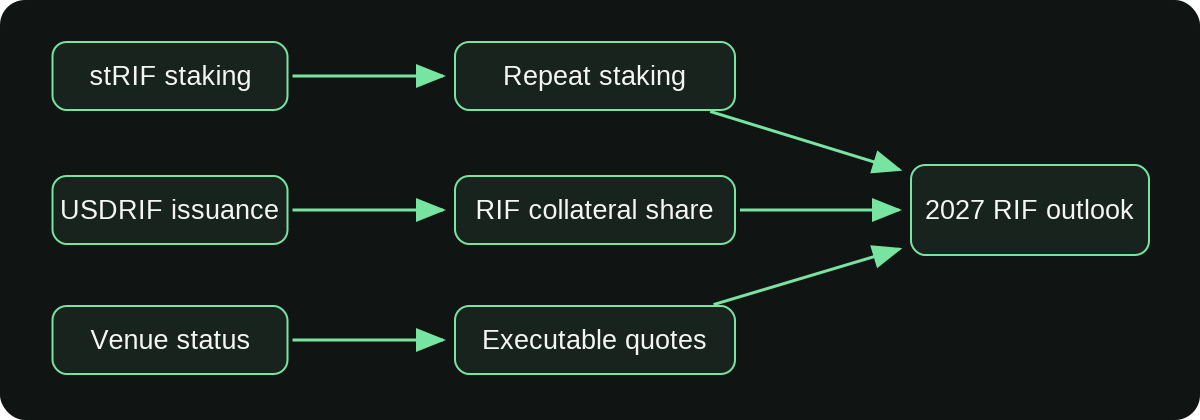
Distinguish Rootstock adoption from reasons to hold RIF
The native gas asset in Rootstock is RBTC. Growth in transactions can therefore matter to the network without demonstrating that the participants acquired RIF. Start with a short list of actions that require or involve the token. RootstockCollective documents how users stake RIF to receive stRIF, which is used in governance. RIF on Chain’s current protocol FAQ describes RIF and DOC as separate collateral buckets supporting USDRIF. Rising USDRIF supply cannot be attributed entirely to RIF collateral without a bucket-level breakdown. Rootstock technology · RootstockCollective · RIF on Chain protocol FAQ
For each direct-use case, ask whether the user regularly needs more of the token. If a program draws on balances participants already held, a new position does not by itself establish a new spot purchase. Check the entry and exit terms as well. A temporary lock and permanent reduction in supply have different market implications. Track the observable action separately from the reason you think it occurred.
What $0.025, $0.055 and $0.10 would imply
| Year-end sensitivity | Approximate value at 1 billion RIF | Evidence supporting the scenario |
|---|---|---|
| $0.025 | $25 million | Weak direct use or deteriorating execution in available markets. |
| $0.055 | $55 million | Existing uses persist with modest market recovery and limited evidence of new demand. |
| $0.10 | $100 million | Sustained evidence of demand across multiple use cases and better market depth. |
The points are valuation tests, with no probability assigned. The supply figure matches the scale shown for the Rootstock contract during the review. A circulating market cap calculation should use the provider’s stated circulation figure for the same date. The result is price multiplied by supply. It cannot tell you how much cash is required to move the market or how much a large holder could withdraw. RIF contract on Rootstock Explorer
What the November roadmap update means for token holders
Rootstock published its post-quantum security roadmap on November 23, 2026. It covers preparatory work affecting the network and its infrastructure. It does not establish an immediate change to the RIF contract or a requirement to move tokens. A valuation claim should identify which feature is live and where a user would subsequently need RIF. Keep the status of a proposal, release or live deployment separate. Rootstock November 23 roadmap announcement
Market access needs its own line. Bitget announced a pause in RIF deposits on the Rootstock network on November 3 due to wallet maintenance. That notice covers deposits in the named network. It is not proof of a market delisting or of the deposit status on November 24. Use a fresh venue status for the action you need. Trading screens, deposits and withdrawals can differ on the same day. Bitget maintenance notice
When a venue changes its deposit status, decide which exposure you are measuring. A holder already on the exchange may still see a spot market, while a holder on Rootstock may be unable to bring inventory onto that venue for a sale. In that case, record liquidity separately for the local wallet and the exchange account. Combining apparent liquidity that those holders cannot both reach makes the exit case look stronger than it is.
A three-part evidence log for 2027
For governance, log what the program requires, balances or comparable participation measures and whether activity persists beyond incentives. For collateral, log the specific underlying asset and protocol conditions rather than assigning all activity to RIF. For the market, capture the venue and a real bid or quote for a specified size when possible. Compare identical observation windows and keep assumptions visible. If network activity rises while your checks show little direct demand or poor execution, reduce the weight placed on the ecosystem growth claim.
Add one field to the log for the overlap between metrics. For example, moving RIF into a governance position changes its form. Counting the original balance and the related receipt token as two independent increases in demand would overstate the event. Similarly, a project's dollar-denominated collateral balance can rise when the collateral price rises, even if nobody adds tokens. Track units of the original collateral as well as their dollar conversion at a matching timestamp. This puts the change in quantity and the change in valuation on separate lines.
Finally, separate changes in BTC and RIF prices from changes inside Rootstock. Compare the two assets over matching UTC dates before attributing a RIF rally to BTCFi. A market-wide move may explain part of the change, and a high correlation over a short window cannot establish causation. Mark which direct-use measures would confirm the interpretation later. Bitcoin’s 2027 outlook
Frequently asked questions
Does RIF track BTC at a fixed ratio? No. BTC-linked infrastructure does not give RIF a fixed BTC exchange rate.
What does a RIF/USD chart show if most usable quotes are in USDT? It may convert several markets into a common dollar reference. Check the quoted pair and conversion if you need the actual amount available in a particular settlement asset.
Does a $0.10 RIF forecast require a move to a new exchange? There is no such arithmetic requirement. Market access, demand and depth affect the evidence for the valuation.