 Coin Price Analysis
QNT would need to rise about 56% from its November 23, 2026 UTC close of $154.16 to reach $240. At a rounded circulating supply of 14.5 million QNT, that would imply a market value near $3.48 billion. The stronger case depends on converting public availability of Fusion into repeat use that creates a verifiable reason to acquire, spend or lock QNT. CoinGecko QNT price history · Quant’s Fusion launch announcement
November 23 opened access to a system already on mainnet
Quant says that Fusion Rollup went live on mainnet in June 2026, with selected users onboarded first. On November 23, it opened access to the public through Quant Connect and described an identity-verification requirement. The announcement identified Ethereum, Polygon and Besu as connected in that rollout. Treat the November update as a change in who can use Fusion. The relevant evidence for 2027 is whether paying or operational use grows after access broadens. Quant’s November 23 announcement and rollout timeline
CoinGecko’s close increased from $143.30 on November 22 to $154.16 on November 23, about 7.6% in the cited series. The timing is worth recording. It cannot establish which buyers reacted to the rollout or how much of the change persisted. Match the asset’s performance with a relevant market benchmark and then assess the project evidence independently. CoinGecko QNT daily closes
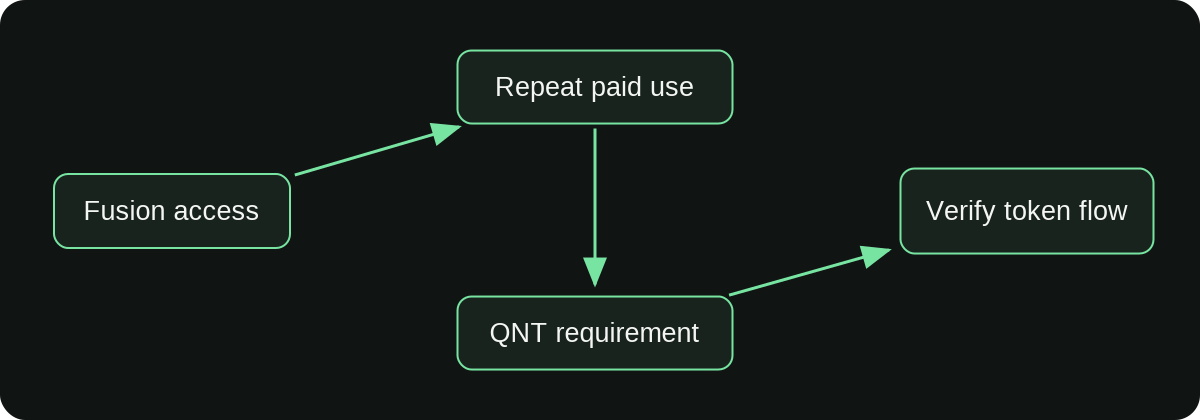
What would turn a customer announcement into token demand?
Quant’s service terms identify QNT as a utility token that customers may use for products or services, including staking. The MiCA whitepaper published by Bitstamp describes Overledger service fees payable in USD or through a QNT subscription and distinguishes those arrangements from Ethereum gas. Before treating a bank or application as a QNT buyer, identify the exact product, fee denomination, payer and whether any intermediary actually sources QNT. An integration can create paid infrastructure use without requiring each customer to buy the token directly. Quant’s services terms · QNT MiCA whitepaper
Use a four-step adoption record. First, mark whether the project describes testing, limited production or broader availability. Second, record the unit of work, such as completed paid settlement or a recurring subscription, rather than registrations. Third, document whose rules make a QNT balance necessary and where those rules apply. Fourth, look for repeated changes in QNT balances, payments or staking. If the usage data is private, identify the missing field instead of estimating a token purchase from a partnership announcement.
Cross-chain activity needs its own scope. Quant describes Fusion as allowing assets represented across several ledgers to operate with a common liquidity approach. The dollar value served by a workflow should not be added up across its representations unless the measurement deliberately counts gross transfers. A gross activity figure can help describe use, but it cannot establish incremental buyers or how much QNT is kept off the market. Quant Fusion overview
What three year-end levels imply
| QNT 2027 sensitivity | Change from $154.16 | Implied value at 14.5M QNT |
|---|---|---|
| $100 | −35% | $1.45 billion |
| $160 | +4% | $2.32 billion |
| $240 | +56% | $3.48 billion |
The 14.5 million input is rounded for valuation arithmetic. Update it with a comparable dated circulation observation before reusing the table. The $100 case captures weaker liquidity or a rollout that produces less recurring use than expected. $160 tests a valuation close to the starting level. $240 requires stronger evidence of QNT use across several periods and deeper markets able to sustain actual trading near the higher price. These are scenario levels with no assigned odds. CoinGecko QNT market data
For a follow-up on actual adoption, request a consistent unit from the public record. If the project reports users, ask whether it means verified accounts, addresses that executed a transaction or institutions with a live workflow. If it reports settlement value, identify the underlying asset and whether the same value appears at more than one stage. For a 2027 price thesis, recurring payments and staking changes are more useful when they can be linked to the new activity over several comparable observation periods.
Supply discipline matters even for relatively small issuance changes. A rounded 14.5 million supply makes the scale legible, while the availability of bids determines what a particular holder receives. A valuation of $3.48 billion does not equal new money required to reach $240. If you want to assess the feasibility of a large order, check real bids separately. Comparing two markets at the same size and timestamp avoids giving too much weight to the last price on a thinner venue.
A clear way to audit a new deployment is to write down three findings before changing the price case. Record the status confirmed by the product owner, the economics the documentation actually specifies, and the independently observable activity. If a paid deployment exists but the token route is optional, leave that qualification in the forecast. Price action after the announcement adds market context and can prompt more research, but it cannot resolve the missing evidence about what users or service providers paid.
Measure that coupling using the period after rollout, once initial onboarding activity can be separated from usage that persists.
Frequently asked questions
Do I need QNT to open the Quant Connect page? Public rollout materials describe account creation and identity verification. The token requirements for using a product depend on the service and workflow.
Is a tokenized sterling deposit issued by a bank equivalent to QNT? They represent different exposures. A bank deposit is associated with the bank and its terms. QNT is the utility token discussed here.
Why can two services report different QNT valuations at the same price? Their circulating-supply definitions or measurement times can differ. Check the supply denominator before comparing targets.