 Coin Price Analysis
OKB would need to rise about 49% from its November 24, 2026 snapshot of $83.74 to reach $125. With 21 million OKB as the valuation denominator, the higher price implies $2.625 billion. X Layer activity matters most when it creates an identifiable reason to spend, acquire or commit OKB. The starting price was a live reading at 11:42 UTC+8. CoinGlass dated OKB snapshot · CoinGecko market data
Put the large burn in the correct year
OKX's August 2025 tokenomics announcement described a one-time burn of 65,256,712.097 OKB from balances accumulated through earlier repurchases and from treasury reserves. The announcement set out a 21 million post-operation total and the removal of minting and burning functions from the upgraded contract. The source also describes OKB as X Layer's native gas token. An analysis for 2027 starts after that event. A separate claim about future recurring purchases or burns needs its own dated evidence. OKX's X Layer and OKB tokenomics announcement
Different uses of supply numbers can obscure the role of liquidity. For arithmetic here, the headline total gives a straightforward denominator. The share sitting on a particular venue and available near its top bid is much smaller and is governed by orders that can change. To compare the $125 case with a different exchange token, write down total supply, the comparable circulating definition and the liquidity for the same order size across both assets. LEO repurchase and market structure comparison
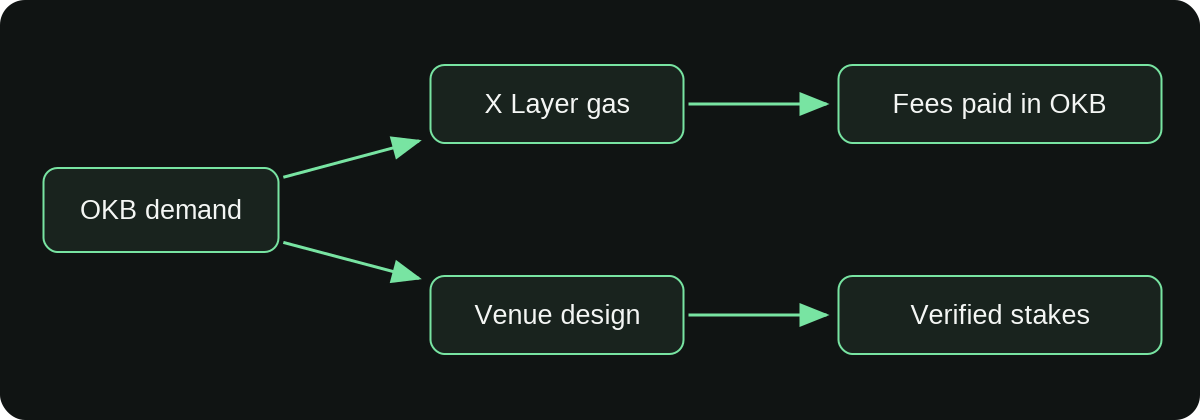
Measure gas demand and proposed venue commitments separately
X Layer usage can lead to gas spending denominated in OKB. The user who registers an account or signs a transaction may have the fee paid by a service. Record how much OKB was actually used in fees and identify who pays when a product sponsors costs. Transaction count, fee paid per transaction and number of fee payers can move at different rates. If low costs help attract users, the quantity of OKB required for each operation may remain modest. X Layer platform information
The X Layer Exchange OS white paper presents another possible source of demand. It describes venue deployers staking OKB. The document is useful for understanding the design, including who would make the commitment. Before moving this into the price model, look for deployed contracts, launched venues and verifiable active balances or terms matching the design. A venue can attract trading activity without producing an amount of committed OKB that is material against total supply. X Layer Exchange OS white paper
A practical way to monitor demand is to maintain two columns. Put network fee expenditure in one, measured in OKB over a fixed time window. Put any verified deployer commitments still active at the window end in the other. A fee series is a flow while staking balances are a stock. Keeping both units clear avoids adding them into a misleading single demand figure.
What a $125 valuation requires
- $55 implies $1.155 billion at 21 million OKB and a decline of about 34% from the dated price reading. This stress case allows for weaker platform access or thinner bids during a market downturn.
- $90 implies $1.89 billion, a gain of about 7%. It represents relatively stable access and continued gas use, even if proposed venue commitments are still difficult to quantify.
- $125 implies $2.625 billion, up about 49%. This scenario calls for credible recurring gas usage or verified commitments, plus usable market depth. Several strong periods of evidence carry more weight than a single launch.
A $10 move translates to $210 million in implied value under this model. That figure is a change in price multiplied by total supply. It cannot reveal how much capital traded in or out.
Check market access before using a price story
Look at the actual trading pair, bid depth, deposit and withdrawal networks, and restrictions for the reader's location. The 2025 OKX announcement describes a planned phaseout of OKB on Ethereum L1 within its support changes. A displayed price on either a centralized or decentralized venue does not establish that the specific token version can reach that venue. If routes change while liquidity is concentrated, a headline composite price may remain separated from the user's executable price for longer than expected.
Monitor how concentrated the price is
Compare the same pair and the same order amount across the venues a reader can actually access. If one venue quotes against a stablecoin and another uses fiat dollars, record the stablecoin-to-dollar rate and any practical conversion charge at the same time. Observe the bid and ask during a calm market and again during a volatile session. A narrow normal-hours spread can coexist with poor execution under stress. Save the quote time and venue so the result can be repeated.
This matters for an X Layer thesis because the gas asset can be useful even if liquidity at a particular venue is shallow. Check whether the exchange and withdrawal routes remain available on the same date as the price sample. A route that becomes temporarily unavailable may leave holders using a less liquid market even when they see a higher composite quote elsewhere. Conversely, a short-lived dislocation on a single venue does not establish that X Layer fee usage changed. Setting these checks beside the gas figures helps keep evidence about platform access distinct from the evidence about product adoption.
If access improves, watch whether the new route consistently adds usable liquidity or primarily moves the same volume between venues. An additional listing shows distribution, while a series of price and depth comparisons provides evidence about the reader's ability to transact.
Frequently asked questions
Is OKB a claim on OKX's revenue? Holding the token gives exposure to OKB's market price and any utility available under relevant terms. Equity rights or a claim to distributions would require a separate documented instrument.
Does gas sponsorship mean the blockchain charges users in stablecoins? A sponsor can pay the underlying network fee while a product presents different billing to its users. Check both layers to identify who needs OKB.
Can X Layer deposits use the same asset instructions as an older OKB listing? Check the exact network and deposit asset in the current venue instructions before moving funds.