 Coin Price Analysis
BGB would need to rise about 72% from its November 23, 2026 UTC close of $1.57 to reach $2.70. CoinGecko displayed an interim November 24 quote of $1.56. One way to test that price case is to separate Morph's economic activity from the policy settings that determine its BGB burn. The reported supply reduction was real according to the Foundation. Its size cannot be used by itself to estimate recurring fee demand. CoinGecko Bitget Token price history · Morph Q3 2026 BGB update
Reconstruct the quarter with three inputs
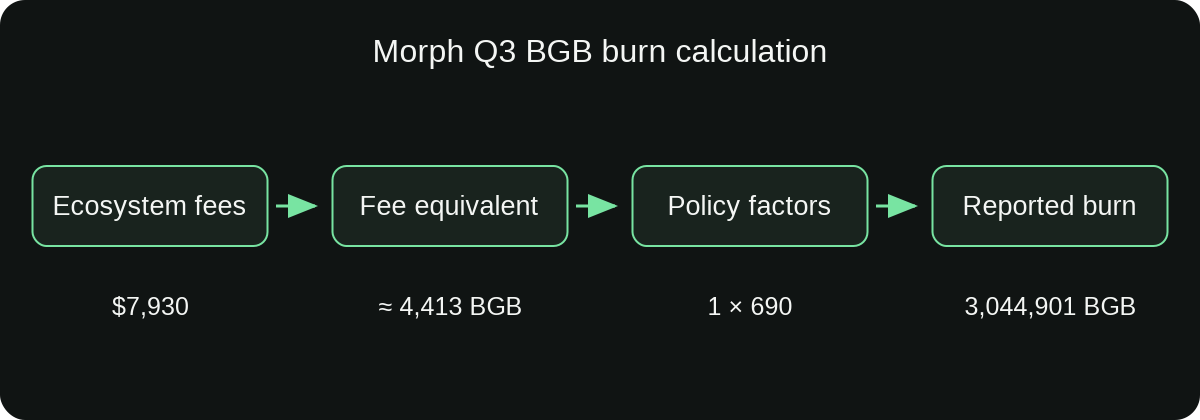
The Morph Foundation reported permanently removing 3,044,901 BGB for Q3 2026. It listed $7,930 of ecosystem fees, an average BGB price of $1.797 and a booster of 690. The fee input divided by the reported average price gives roughly 4,413 BGB before the booster. With a governance factor of one as described, the booster explains most of the difference between the fee-equivalent calculation and the final burn size. Morph's Q3 burn report and calculation · Morph's published tokenomics formula
One intermediate line in the report lists 2,120 multiplied by one, followed by a result of 4,412.9. That line is internally inconsistent. Use the published fee and average price to reconstruct the approximate fee-equivalent figure, and use the final amount as the Foundation's reported figure. When precision matters, save the transaction reference and identify the contract and destination used for the burn. The report and the underlying transaction answer complementary questions.
Track how people use BGB across two environments
Bitget markets BGB as a token used for benefits within its ecosystem. Morph describes BGB as its native token, including use for network gas. Exchange benefits may create a reason to retain tokens on the platform. Network fees can be paid as part of actual chain activity. In either setting, seek a measure of balances held or tokens spent before assigning a value to the headline user count. Bitget's BGB product overview · Morph's native-token announcement
The Q3 report said Morph Payments was onboarding design partners and that Morpho was live on Morph. For a 2027 valuation, record the stage of each product and look for comparable observations after launch. A live deployment answers whether integration is possible. Active customer payments and amounts actually paid for execution tell you whether demand is using the integration. When users receive subsidized fees, identify who paid and whether the spending is likely to continue after incentives expire. Morph Q3 ecosystem update
How to read the $2.70 case
At 700 million illustrative circulating BGB, $0.90 implies $630 million and a decline of about 43%. It stress-tests low fee growth and weaker bids on markets with significant token liquidity. $1.80 would imply $1.26 billion, about 15% above the reference. Moderate ecosystem demand and ordinary liquidity could fit that case. $2.70 would imply $1.89 billion, up about 72%. A stronger case would show gains in fee generation that hold up after controlling for the multiplier, as well as sustained changes in usable spot depth. CoinGecko BGB market data
The scenarios have no assigned odds. To adjust price for supply, divide the implied value by the revised circulating estimate. A $1.89 billion valuation at 750 million circulating BGB would be $2.52 per token. Supply series can differ in their treatment of Foundation-held, bridged or reserved balances. Document the definition on both sides of a before-and-after calculation.
What to record next quarter
Record ecosystem fees, the average BGB price used in the calculation, the announced multiplier and the executed burn as separate fields. Calculate the fee equivalent with the same formula each quarter. Then calculate the percentage change in fees and the percentage change in the executed burn. If the two diverge, compare the price input and policy factors before making a statement about usage. A larger burn can coexist with modest economic activity when parameters change or token prices fall.
For a separate liquidity check, compare two markets on the same settlement asset and realistic order size. A narrower displayed spread can look encouraging while depth beyond the best bid remains thin. This is one reason utility data and trading conditions belong in separate columns. The onchain fee thesis and the ability to exit a position represent different exposures. OKB and X Layer comparison
A burn can rise when the token price falls
Morph's formula places average BGB price in the denominator. Holding fees and the other terms constant, a lower average price raises the number of tokens that the formula would burn. A larger token count can therefore be compatible with unchanged fee revenue. For historical comparisons, calculate what the same period would have produced if the prior period's price and multipliers had applied. That counterfactual helps identify whether the main change came from commercial activity, price or policy. It is an arithmetic comparison without a forecast of how the Foundation would act under different market conditions.
The announced burn represents about 0.44% of the illustrative 700 million circulating basis. This percentage is a way to compare scale with the assumptions in this article. It is not a reconstruction of the official supply percentage, which requires the project's starting supply definition for the relevant interval. Record whether the removed tokens had been circulating under your data provider's convention before making any deduction from its supply series.
Finally, report a transfer between chains as a change in location unless the documented transaction also changes aggregate supply. A swapped or bridged balance may reappear in another representation. Review the two sides as one economic position where the bridge or swap documentation calls for that treatment.
Frequently asked questions
Does a burn transaction identify a market buyback of the same size? A burn identifies a removal event. To establish when the tokens were acquired and at what price, look for purchase records or a documented source of the burned balances.
Can an older BGB deposit address accept a transfer on Morph? Use the current venue instructions for the trading account and select the supported asset and chain. An identical-looking address does not establish that the deposit route is enabled.
Do the same BGB benefits apply to every Bitget account? The availability and terms of benefits can depend on region, account and product. Check the live product terms before estimating a savings figure.