 Coin Price Analysis
Venice Token would need to gain about 63% from its November 23, 2026 UTC close of $24.53 to reach $40. For that case to rest on Venice’s business rather than a broad rally in AI tokens, there would need to be observable demand to lock VVV for compute or recurring burns that meaningfully offset emissions. Revenue, AI traffic and the VVV supply change each answer a different question. CoinGecko VVV history · Venice token FAQs
Start with the role of DIEM
Venice documents a route in which a holder stakes VVV and locks the staked position to mint DIEM. Under its published service terms, one DIEM provides access to $1 in Venice API credit per day. That credit is denominated for service use. It is distinct from a dollar cash balance or a promise about what DIEM will trade for. For someone comparing access routes, the relevant question is how much usable inference is delivered through the service over the period. Venice token and API FAQs
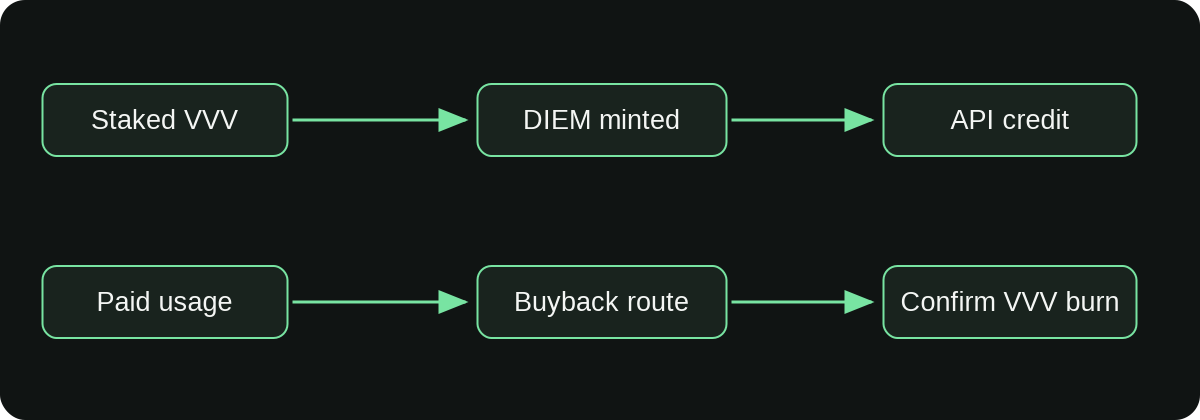
Two things can happen in parallel. Demand for tokenized access may lead some users to lock staked VVV. At the same time, other customers may use credits or paid services through a different route. A larger credit spend gives information about the product, while the net change in VVV committed to the minting route describes a token effect. Where aggregate readings are unavailable, keep the product and token quantities separate.
This also matters if someone uses the price of DIEM to infer VVV demand. Check the amount of VVV that was actually locked, the applicable mint terms and the path for unwinding a position. An increase in the market value of already existing DIEM can happen without more VVV being committed. A flow can also reverse if users free collateral later. Treat the net change as a period measurement instead of adding up every related token transfer.
Compare emissions with burns in VVV units
Venice’s FAQ lists annual emissions of 2 million VVV from October 1, 2026. The July tokenomics update describes a new source of programmatic burns tied to credit purchases. The project also documents buy-and-burn activity linked to subscriptions. These provide mechanisms to check and dated policy references. They do not supply a fixed future annual burn rate. Annualizing a short busy window can overstate how much recurring demand reaches the token. Venice FAQs · July credit-burn update · Subscription buy-and-burn explanation
Build a two-column ledger. In the first, enter tokens emitted for the observation period. In the second, enter tokens irreversibly burned in that same period, with transaction references and the reason for the burn. Keep VVV staked or otherwise locked in a separate line. That supply may affect the float, but it can become available again under applicable rules. The arithmetic break-even on emissions and burns is approximately 2 million per year at the stated emissions rate, before any other supply changes. This is a threshold to test against evidence.
Venice’s October changelog, published in November, describes paid tiers charging credits across models without the previous experimental waivers. That is relevant to how the service accounts for usage. A credit deduction gives neither the amount of revenue received nor the amount of VVV burned on its own. Compare actual burns before and after the change before assigning it a valuation effect. Venice October 2026 changelog
For a market sanity check, compare the $26.52 observation on November 22 with the $24.53 close on November 23, a drop of roughly 7.5%. A move of that size can change the value of a VVV position while the dollar-denominated service credit per DIEM stays the same. If you are comparing the cost of tokenized API access with pay-as-you-go, separate token acquisition and exit prices from the service amount you can use in a day. Record actual usage and unused capacity instead of treating each day’s entire entitlement as money saved. CoinGecko VVV price history
For a supply comparison, keep the identities of the two tokens in each column. A transaction involving DIEM can signal demand for compute. To infer a VVV effect, identify its underlying lock or fee path. This is particularly useful if both assets rise in a market rally but the amount locked stays unchanged.
What $40 would mean with 50 million circulating
| VVV 2027 stress point | From $24.53 | Implied value at 50M VVV |
|---|---|---|
| $12 | −51% | $600 million |
| $25 | +2% | $1.25 billion |
| $40 | +63% | $2.00 billion |
The 50 million input is rounded for comparison and sits near the scale in the current market data. Change it to match the circulation figure you are testing. An emissions rate cannot supply that figure by itself because circulation can change through unlocks or transitions in how reserves and balances are counted. The $40 case would be easier to support with repeated fee-funded burns and a durable response in compute-related locking. Weak usage or worse execution could support the lower case even if models keep shipping. CoinGecko VVV market data
Frequently asked questions
Does staking VVV pay a yield in dollars? The staking reward and its dollar value are separate. Check the reward asset and terms, then translate the actual token amount at the price applicable to your situation.
Should I compare Venice API plans by their listed credit totals alone? Compare the models you use, their rates and how much credit you can actually consume. Different workloads can use the same monthly entitlement at very different speeds.
Can I value the token using a venture funding valuation for Venice? A valuation for corporate equity refers to a different instrument. Track the service and token connection through documented rules and executed activity.