 Coin Price Analysis
Dogecoin would need to gain about 113% from its November 23, 2026 UTC close of $0.056346 to reach $0.12. With an illustrative year-end supply of 162 billion DOGE, that would imply a market value of about $19.44 billion. The useful questions are how much DOGE is newly issued, whether investment products actually accumulate the coin and whether demand survives beyond bursts of attention. CoinGecko DOGE historical data
Put the new coins into the calculation
Dogecoin’s published monetary policy describes issuance of about 5 billion DOGE a year. Dogechain reported about 156.87 billion DOGE in its supply series for the week of November 17, 2026. Adding roughly one year of normal issuance produces an illustrative scale near 162 billion. The actual amount at a particular date depends on blocks produced and the supply convention. The annual addition is expressed in DOGE. Its percentage of existing supply falls as the supply base expands. Dogecoin issuance FAQ · Dogechain supply chart
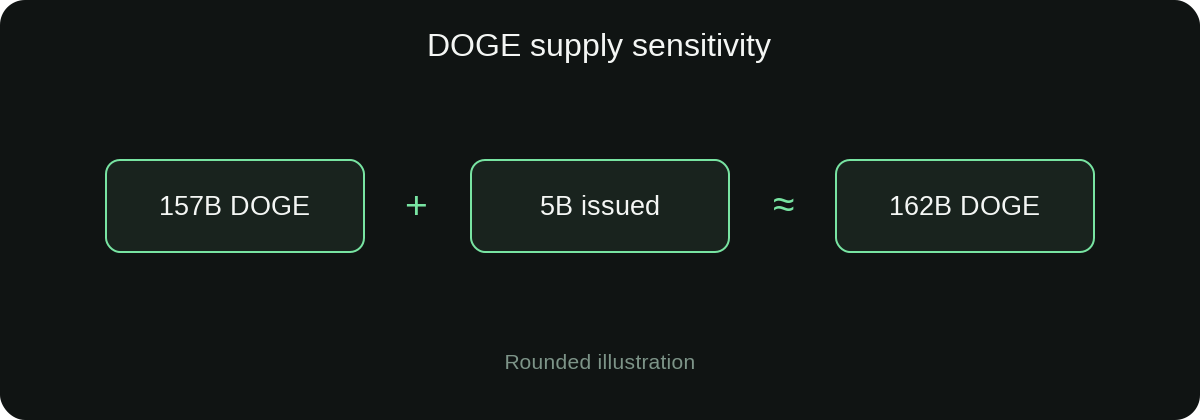
At a fixed market value of $12 billion, dividing by 157 billion yields roughly $0.0764 per DOGE. Dividing by 162 billion yields about $0.0741. This isolates the effect of a larger denominator. It says little about the direction of demand and does not imply that miners sell every new coin. If someone tries to estimate daily sell pressure, ask for evidence of sales and the venues where they occur. Issuance records can establish creation. They cannot reveal how much miners decided to sell.
Read ETF filings as a series, starting with units held
In a Form 10-Q filed on November 5, the Grayscale Dogecoin Trust ETF disclosed approximately 144.88 million DOGE held as of September 30. Its prior quarterly filing lists a separate June snapshot. Comparing the same DOGE line across reports is more informative than comparing assets in dollars alone, since the investment’s fair value can rise as the coin becomes more expensive. Share changes add context, but a holding amount is a snapshot and may also reflect sales to cover expenses. November filing index · September quarter holdings · June quarter holdings
The product name alone can also mislead. Bitwise announced the liquidation and closure of its BWOW fund effective September 10. That event has a different scope from the continuing Grayscale disclosure. Check the issuer, ticker and effective date before adding a headline to a market-wide demand estimate. Treat quarterly holdings and current secondary-market trading activity as different measurements. Bitwise closure announcement filed with the SEC
For scale, Grayscale’s reported quarter-end balance was about 2.9% of one year's approximate issuance. This comparison is between a balance and a flow. It does not say the fund bought that amount during the quarter, absorbed that percentage of newly mined coins or will continue at that pace. It does show why the existence of an investment product alone gives little evidence about the amount of new demand.
Set up a quarterly table with units held, net share changes if the report provides them, and the supply reference for that date. Then add a separate column for comparable spot depth. An increase in one fund's coin balance while spot bids on several venues get weaker would give mixed evidence for a recovery. A stronger case would include consistent changes in several independent measures. A rise in the same fund’s dollar NAV and dollar trading volume is less informative because both can increase when the coin rises.
To compare DOGE with another meme asset, use the same valuation convention. One coin may add new supply continually while another has a very large pre-existing supply. A chart of unit prices cannot correct for that difference. Use the dated circulation of each asset and keep the specific issuance mechanism visible.
What the 2027 levels imply
| DOGE price sensitivity | Change from $0.056346 | Implied value at 162B DOGE |
|---|---|---|
| $0.035 | −38% | $5.67 billion |
| $0.075 | +33% | $12.15 billion |
| $0.12 | +113% | $19.44 billion |
A sustained move toward $0.12 would be easier to support if activity broadened across venues, spot depth improved and changes in reported coin holdings offered independent evidence of demand. The $0.035 case becomes more relevant when traded prices weaken and selling a fixed quantity produces progressively worse quotes. The intermediate point tests a recovery without assuming a repeat of past highs. None of the cases is a statistical boundary. Markets can move beyond all three.
If a headline claims merchants are buying DOGE, first identify who supplies inventory. A checkout service can convert received DOGE to fiat automatically, and a merchant can use the service without holding DOGE. Compare evidence of recurring payments with any evidence of change in balances. Meanwhile, measuring execution requires checking an actual bid for a specified quantity on a venue the holder can use. These are tasks for different data.
For long-horizon comparisons, recompute the same price at the new supply rather than moving your preferred price target automatically each year. This makes it possible to tell whether a higher valuation is justified by new evidence about demand or simply reflects more DOGE outstanding.
Frequently asked questions
Does the recent USD close have to match the close on my DOGE/USDT exchange? No. A multi-venue USD series aggregates markets. A DOGE/USDT candle reflects one venue, a different settlement asset and its own cutoff.
Can several big Dogecoin addresses belong to the same entity? Yes. An entity can use multiple addresses, and a custodian can use one address for many customers. A balance ranking alone cannot identify individual owners.
How much would $1 DOGE imply under the same supply assumption? At 162 billion DOGE, it implies about $162 billion in market value. The gap between that valuation and the $0.12 case is a useful scale comparison. Shiba Inu’s separate valuation test