 Coin Price Analysis
Notcoin would need to rise about 239% from its November 23, 2026 UTC close of $0.00029539 to reach $0.001. At a rounded 99 billion circulating NOT, that would mean a market value near $99 million. The route to that level depends on how often an app actually requires NOT, whether users keep returning after incentives end and whether enough liquidity exists to sustain trades near the higher price. CoinGecko’s NOT history · CoinGecko’s NOT supply snapshot
The original game explains distribution
Notcoin began as a Telegram mini-app built by Open Builders. Players could tap an on-screen coin, accumulate in-game points and later participate in conversion when the token launched, subject to the program’s rules. Its launch story explains why a big Telegram audience found the token. A historical signup count measures past reach. A forecast for 2027 needs a different number, such as how many active users actually choose a feature that requires NOT or how much NOT a recurring service collects. Notcoin’s crypto-asset whitepaper · Notcoin’s project overview
The official community channel has promoted games, digital goods and giveaways. Some rewards advertised there included Telegram Gifts, stickers and in-game items. Read the terms of a particular offering before attributing its activity to NOT. A campaign may reward holders, spend NOT as a promotional budget, accept it as payment, or use a different asset altogether. Each observation has a different effect on the token. Notcoin’s official community updates
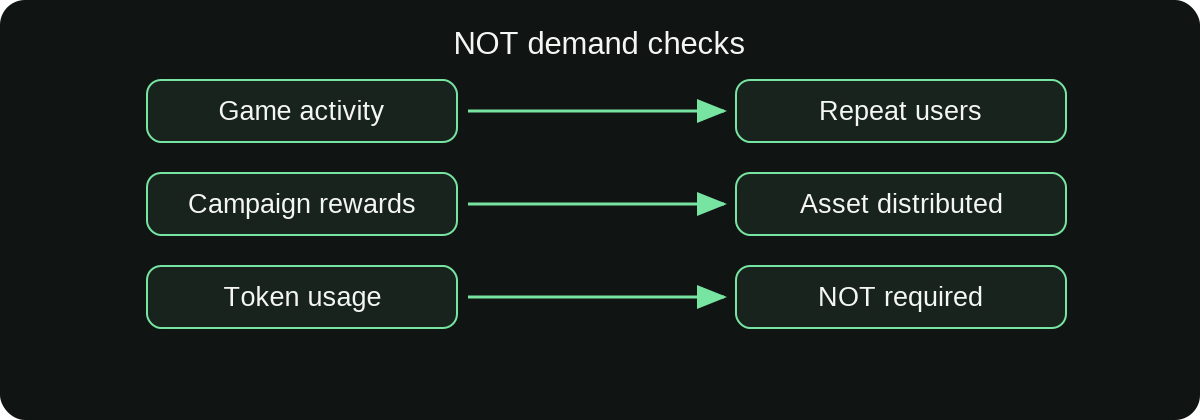
Use a three-line weekly log to test demand
| Record | What to count | What it tells you |
|---|---|---|
| People return | Repeat activity over multiple comparable weeks, with the source’s user definition | Whether attention survived the initial campaign |
| A feature uses NOT | Executed purchases, fees or another action whose rules specifically require NOT | Whether the product creates a reason to source or spend the token |
| Rewards enter the market | The denominating asset, the transfer dates and whether balances become available to trade | Whether incentives added liquid supply during the same period |
Start with a named game or marketplace so you have a common scope. If you can see transactions but cannot observe whether the same people returned, keep the retention line blank or label the proxy you use. Multiple wallets can belong to one person, and an operator can batch activity for different users. The point of the log is to keep the evidence auditable, including what is missing.
Also separate user spending from sales by reward recipients. A program can produce visible on-chain transactions while funding all activity from a temporary pool of rewards. An end-of-campaign comparison can establish whether buyers continued to spend when rewards fell. For broader chain activity, the Gram price outlook explains how to test demand for TON’s native asset separately.
Pay attention to the difference between a stock and a flow in a game economy. An announced reward pool is an allocation. A week of purchases is an observed flow. For a comparable period, document how much of the pool was actually paid and, separately, how much NOT users spent. If the offer is denominated in another asset, keep that line in its original unit rather than putting it into the NOT column after a conversion.
CoinGecko’s price series shows $0.00028980 on November 22 and $0.00029539 on November 23, up about 1.9%. That movement gives a dated reference for recent variability. It cannot establish that a game update caused buyers to return. Check for a contemporaneous, source-linked change in use before assigning a catalyst to the move. NOT historical data
How the 2027 price levels scale
| NOT stress point | Change from the November 23 close | Implied value at 99B NOT |
|---|---|---|
| $0.00015 | −49% | $14.85 million |
| $0.00045 | +52% | $44.55 million |
| $0.00100 | +239% | $99.00 million |
The upper level tests a little over three times the reference price. Evidence in its favor would include ongoing token use across more than one product and improving spot liquidity. The middle level is a recovery test with some continued use, while the lower level helps assess the consequences of fading attention and lower available bids. These round levels do not carry probabilities. They illustrate the size of a move under common assumptions.
When prices rise on one platform, check whether the move carries over to markets you can settle on. Compare available bids for the same amount and note the quote asset, fees and withdrawal status. A high last traded price on a shallow book may apply to a small order only. If buyers and sellers face different routes to move tokens, a cross-venue comparison should include those restrictions. CoinGecko’s market page publishes depth alongside reported volume, which gives readers one place to start comparing. CoinGecko NOT markets
Changes in game rules can interrupt a retention series. If a campaign shifts from paying rewards for a first visit to paying for repeat play, start a fresh comparison period. Record the rule change next to the results and compare players who faced the same conditions. This avoids attributing the entire jump in repeat sessions to stronger independent demand.
Frequently asked questions
Do I need a Telegram account to hold NOT? You can hold the on-chain jetton in a compatible TON wallet. A particular game or distribution may still require Telegram under its own access rules.
Can I use a NOT/GRAM chart as a USD forecast? The pair measures one token in units of the other. A NOT/GRAM rally can happen without a USD rally if GRAM falls far enough.
What should I verify before counting a new NOT burn? Check the actual jetton contract, the transaction and how the provider treats the event in its supply series. A ticker match alone cannot establish that the original token was affected. TON’s jetton comparison