 Coin Price Analysis
The 2027 outlook for Gram, formerly Toncoin, depends on whether TON applications create recurring demand for the native asset. CoinGecko’s last completed close in the retrieved history was $0.988484 on November 23, 2026 UTC. $0.65, $1.00 and $1.50 are illustrative stress points, with the upper level requiring about a 52% increase from that observation. Telegram usage alone cannot establish that path. CoinGecko Gram history · Issuer disclosure filed with the SEC
First, verify the price series and the name
By November 24, CoinGecko redirected its old Toncoin history to Gram (GRAM). A public-company filing describes the June 2026 rebrand as a change to the name and ticker. Kaiko published its own June 15 rebrand notice about data and venue handling. The dates on governance, provider and exchange communications may describe different events. When building a chart, match the native chain and provider asset identifier, record the date a venue changed its display and make sure pre- and post-rename observations belong to the same series. Kaiko market data notice · TON documentation
Do not mix this series with another token named Gram. A symbol can change while price history continues. A price screen that shows an old symbol may also be a stale interface. Before any transfer, check the venue’s instructions for its native TON route, the asset identity and deposit status. A price prediction page should never be used as proof that a swap or migration is needed.
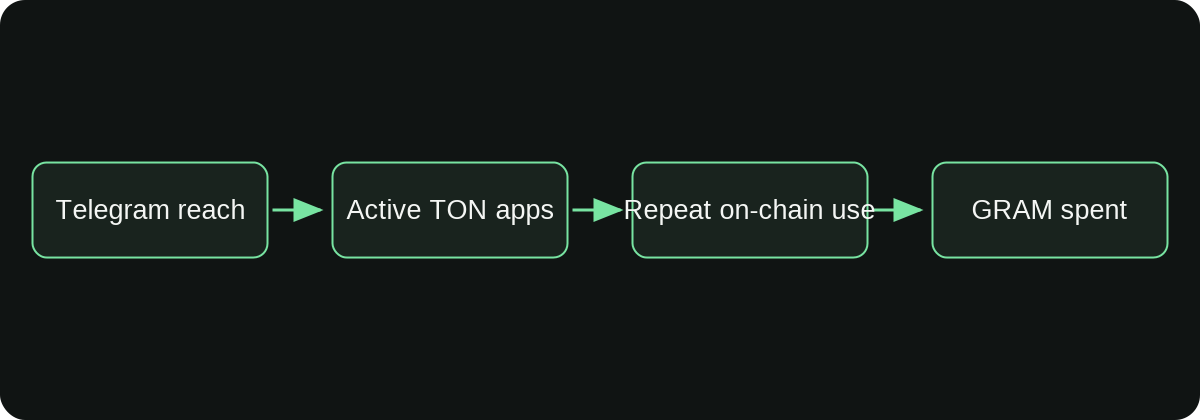
Translate Telegram reach into measurable activity
Start with a concrete action, such as paying in an app or transferring an asset. Determine which part uses TON and what the user actually holds. Telegram’s Mini Apps are third-party products. A user opening a Mini App might not sign a transaction at all. Someone sending a stablecoin on TON might use native GRAM for fees through the applicable arrangement, but the size of the stablecoin transfer does not equal the amount of GRAM demanded. Telegram Mini Apps terms · TON documentation
| Evidence | Interpretation |
|---|---|
| More users open a Mini App | Broader reach. It does not identify on-chain users. |
| More users return and complete a documented on-chain action | Better evidence of persistent use. Check who pays fees and in which asset. |
| Higher repeat use alongside usable spot depth and stable access | Stronger evidence for a sustained demand case. |
| A temporary campaign followed by lower engagement | Reason to discount extrapolation from the campaign period. |
Compare the same product before, during and after an incentive. Look for repeated paid actions and a stable definition of an active user. An address count may include service wallets or automated activity. Avoid converting it directly into unique Telegram accounts. Write down what the data can verify before describing it as adoption.
TON’s own site lists different entry points, including the wallet in Telegram and ways to pay for Stars using Gram. An entry point tells you a user can take an action. Forecast evidence requires knowing what settles, which asset is spent and whether the user comes back. For instance, a payment surface could offer several ways to fund a payment. A count for the entire surface cannot tell you the amount of Gram purchased or spent. If an integration gives only signup totals, keep those in a reach column and leave the native-token demand column unmeasured until there is usable evidence. TON ecosystem overview
What $0.65, $1 and $1.50 assume
$0.65 is a risk-off test in which activity proves short-lived or execution conditions deteriorate. $1.00 is a near-anchor test. It is about 1.2% above the dated close and would not by itself demonstrate significant growth in demand. $1.50 tests a stronger outcome in which repeat activity, native-asset use and market depth improve together. The levels are chosen benchmarks, with no assigned odds. From $0.988484, the downside test is about 34% lower.
To make your own market-value comparison, multiply each level by the same dated circulating supply. When you move the forecast forward, update the supply assumption before comparing the numbers. Verify how the data provider treats staking or other restrictions. One exchange’s available inventory should not stand in for circulating supply.
Watch failure conditions alongside the upside story
Check regional access, wallet support and venue liquidity independently. The visibility of a Mini App inside a messenger does not establish that the same user can buy, withdraw or sell GRAM in their jurisdiction. Compare the official listing and withdrawal instructions. Record how much can actually be traded at the quoted price. A growing user-facing ecosystem can coexist with a thin execution venue.
At each review, save the source, date, and the step in which the native asset is required. If the project adds a feature but most users follow a route without recurring GRAM demand, lower the weight you place on raw usage growth. If broader use persists and liquidity improves, the stronger scenario is better supported, even though the exact price remains uncertain.
The settlement asset and the party that acquires it may be different from what a customer sees at checkout. If a service supplies GRAM from existing inventory, distinguish the amount it spends from the amount it subsequently buys to replenish that inventory. The first shows on-chain utility. The second provides more direct evidence of demand in the market.
Frequently asked questions
Can a CoinGecko redirect create a break in backtests? Stored ticker strings can break a spreadsheet join. Merge only after confirming both series belong to the same provider asset or reconciling the identifiers.
Does staking change the way to read the quoted price? The market price is for one unit of the asset. Staking rewards, withdrawal restrictions and opportunity cost affect a particular position separately.
Should a RUB or EUR reader use the same levels? The article’s levels are USD references. Convert the entry and exit on corresponding dates and use an executable route for local-currency costs.