 Coin Price Analysis
At SHIB’s November 23, 2026 UTC close of $0.00000364, a rise to $0.000010 would be about 175%. With 590 trillion SHIB as a round supply input, that level implies a $5.9 billion market value. The arithmetic makes two issues visible. A large token-count burn can represent a tiny fraction of a very large supply, and the market value can move independently of changes in circulation. CoinGecko SHIB price history · CoinGecko SHIB supply data
Translate the burn count into a supply percentage
At the same illustrative 590 trillion supply, one billion SHIB is approximately 0.00017% of that amount. Even 100 billion SHIB would represent roughly 0.017%. These are arithmetic scale tests. They are not claims that either burn occurred in November. Comparing results in percentages also helps spot when an article is quoting a change in daily burn activity instead of a change in all SHIB outstanding. A tenfold increase in a small daily count can still leave the supply measure practically unchanged.
Now hold market value steady and ask what a burn alone would have to accomplish. Moving from $0.00000364 to $0.000010 at the same valuation would require supply to fall to about 36.4% of the starting value. This would mean removing roughly 63.6% of the assumed supply. The calculation offers a reality check for a burn-only narrative. A move of that scale could occur through a repricing even if circulation changes little, which is why market demand has to be modeled independently.
Trace the fee-to-burn path
The Shibarium documentation identifies BONE as the network’s gas asset. Its ShibTorch interface shows a BONE balance allocated for burning and presents a process for turning accumulated fees into SHIB burns. To test a claim about SHIB, follow the full path through to a confirmed disposition of the SHIB. The presence of a gas fee in BONE or an announced burn establishes an earlier step. Shibarium network documentation · ShibTorch burn interface
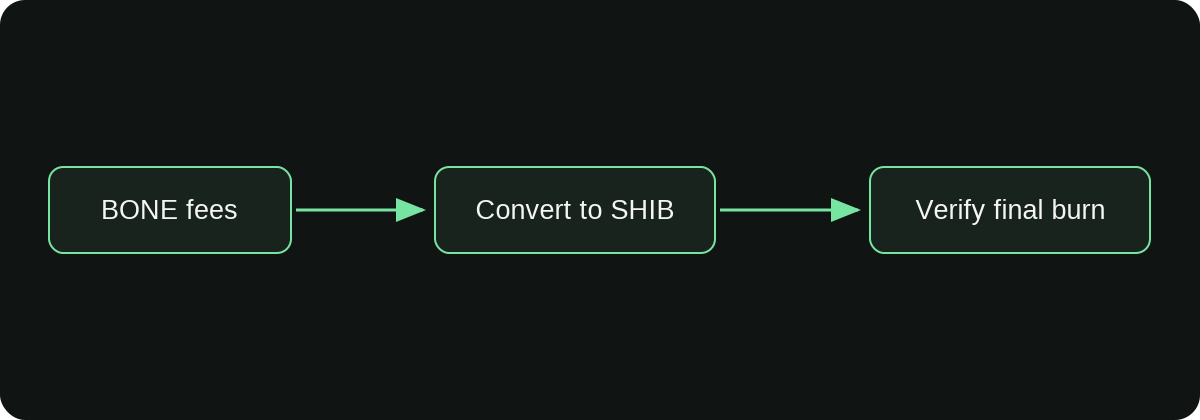
Use three entries when updating a burn log. First record the chain and fees collected. Next record the conversion or related bridge event if one is relevant. Finally record the SHIB transaction and inspect the full amount and destination in the appropriate explorer. Deduplicate the stages so a purchase, transfer and burn of the same SHIB appear as one reduction. Data tools can also classify transfers to a designated dead address differently from a contract-level reduction. State the definition used in your circulating estimate.
November coverage highlighted inconsistent short-term burn readings. If a headline compares yesterday with today, compare the absolute totals and confirm that the ledger covered the full days. Treat incomplete windows and rediscovered old transactions separately. The durable figure for a 2027 case is the verified change across a consistently observed period, together with the size of the supply that could trade. Shibarium explorer guide
In a November filing, North American Derivatives Exchange described a SHIB strike event contract for listing on or after November 14. It references the price at a defined time. A product that settles on a price condition gives participants a distinct way to take price exposure. The filing does not describe an equivalent spot purchase or withdrawal of SHIB. If an announcement mentions new derivatives access, keep it separate from evidence of spot accumulation. Exchange’s SHIB event-contract filing
There is one additional accounting trap. Providers may already exclude historical dead-address balances from their current circulating estimates. Start the forecast with the published base and subtract only a new reduction that the base has not counted. Subtracting old removed balances a second time makes every price point appear easier to reach.
Three price levels with different demand requirements
| SHIB stress point | Move from the dated close | Implied value at 590T SHIB |
|---|---|---|
| $0.00000250 | −31% | $1.475 billion |
| $0.00000500 | +37% | $2.950 billion |
| $0.00001000 | +175% | $5.900 billion |
The lower level fits a scenario in which attention fades and spot liquidity weakens. The middle point is compatible with a market recovery even if reported burns remain modest. The high point requires a much larger valuation at the same supply. To assess it, check recurring demand, sustained depth for your intended transaction size and whether recent reduction in supply meaningfully changes the market-cap arithmetic.
A thin market can produce an impressive percentage move while leaving buyers or sellers with poor fills. Choose the size you want to compare and record both the quoted midpoint and the actual expected proceeds. A small order that fits near the midpoint tells you little about the price for a much bigger sale. In 2027, interpret a short-lived spike as different evidence from a liquid market that holds a new range after attention has moved elsewhere.
SHIB is an Ethereum token with a separate ecosystem fee mechanism. For a Solana-based example of how tiny token prices and different mint rules affect comparisons, see BONK’s 2027 valuation review.
Keep the quoted percentage and the number of tokens in the same record. That makes very large changes in the reported daily burn rate easier to interpret when the previous day’s total was close to zero.
Frequently asked questions
Why does my exchange round SHIB to $0.00? The price has more decimal places than some interfaces display. Check a fully expanded quote and the order’s total in dollars or the actual quote currency.
Does putting SHIB in a bridge destroy the original balance? Check the bridge’s actual lock, mint and redemption design. A locked balance may still back a representation elsewhere and need not be permanently unavailable.
Can a SHIB perpetual price drift from spot? Yes. A perpetual reflects its index, funding and positioning. Compare the relevant spot bid when estimating how much an actual token sale would yield.