 Coin Price Analysis
USDD’s 2027 price reference is $1 if its collateral system and usable swap routes continue to support it. The November 23, 2026 daily USD record in Crypto Street’s history was $0.9990 at the displayed precision. That observation is close to par. For the next year, the key questions are which version of USDD you hold and whether the route out of it has enough inventory for your amount. USDD daily price history · USDD 2.0 documentation
Verify the version before comparing charts or yields
USDD’s documentation describes the newer version as a dollar-targeted token backed by crypto collateral. JustLend previously announced a transition from incentives for USDDOLD to incentives for USDD V2.0. When reading an exchange announcement or chart that uses the same ticker, match the token contract, network and program. An old deposit address or outdated market can refer to the earlier version. USDD 2.0 overview · JustLend upgrade notice · Official USDD contract list
On November 17, JustLend updated its announcement for phase 24 of USDD V2.0 supply mining. The notice described an approximately 4% APY for the phase that began November 7 Singapore time and was scheduled to end December 5, with the rate subject to adjustment. A time-limited incentive can affect how much is deposited in one application. Treat it as separate from the dollar price and from revenue or yields available after the phase ends. JustLend phase 24 notice
Watch vault collateral and swap inventory separately
In the vault system, borrowers deposit eligible collateral to generate USDD. A vault can become eligible for liquidation if its ratio falls below the applicable threshold. This process is meant to keep the token backed, but it depends on the value of the collateral and how effectively the system can process liquidations. A dashboard can show aggregate coverage while an individual collateral market faces sharp moves or limited bids. USDD’s system architecture
The peg stability module addresses another question. USDD documents swaps with supported stablecoins, including routes involving USDT or USDC. Confirm the available direction, inventory and actual transaction terms. A module’s quoted rate is useful only if it can fulfill the amount and you can use the output. Receiving another stablecoin adds exposure to its own market or exit route. USDD’s PSM user guide
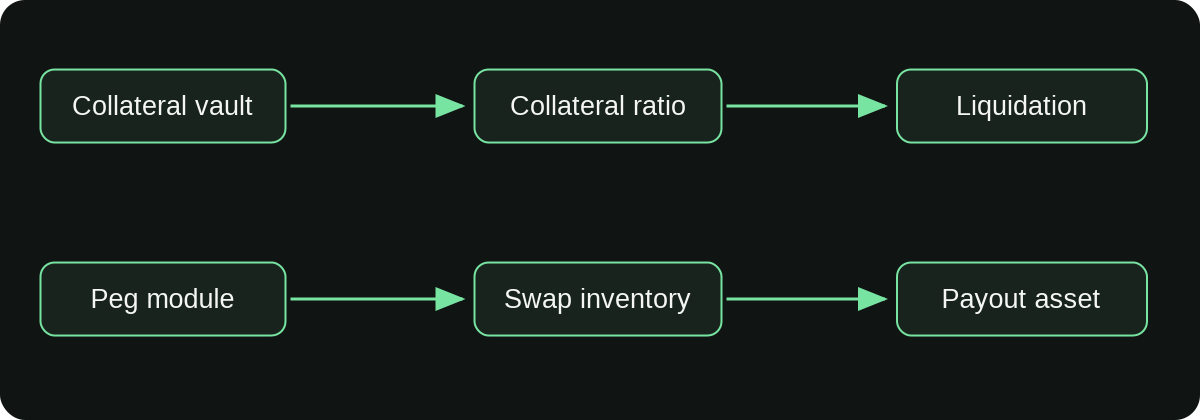
Use two stress scenarios instead of a growth curve
In an inventory stress, a preferred swap route may be too small or temporarily unavailable. Check alternative routes that accept the exact token on the holder’s network. Compare their tradeable quotes at the same size and verify what the second asset is worth in dollars. A thin exit on one route can widen its discount even while the vaults remain adequately collateralized.
In a collateral stress, price drops or delayed liquidations can make backing harder to realize while swap demand increases. Review the mix of vault collateral, recent liquidation outcomes and the balances available in the relevant swap module. If a shortfall appears, check which record it refers to. A pool can have too little swap inventory to serve a sale while the rest of the system is still operating. Aggregate collateral and immediate conversion capacity answer different questions.
An illustrative two-leg exit for 5,000 USDD shows why the final asset matters. If the first leg gives one USDT per USDD but the eventual USDT bid is $0.998, the resulting dollars before fees would be $4,990. A $10 difference at that amount can come entirely from the final conversion. Keep both legs in the model. Tether’s own market and exit analysis
Build an inventory check before looking at APY
Start with the contract appropriate to the network. Record the output asset, the inventory or capacity observed for that side and the total size you need. If the quoted rate applies only up to a smaller size, split the calculation into the portion available through the module and the remaining portion that must use another market. Price the second portion independently. Keep the same timestamp for both estimates as far as possible. This reveals whether the constraint is the rate or the amount. USDD contract addresses
For the collateral side, track the exposure by asset as well as the system-wide result. A fall in the price of one heavily used asset can matter more than an equivalent fall in a small collateral market. Evaluate the concentration alongside realized liquidation outcomes and available swap inventory. A system-wide ratio can be useful as a warning indicator, but it cannot establish the proceeds of your own trade. In a volatile period, repeat the observations and retain a record of the time the reserve, inventory and price were each measured.
If you are comparing a lending position with a liquid balance, account for the steps necessary to make the lending claim transferable or withdrawable before selling. A program may display a current yield determined by incentives and utilization. The yield is a measure of potential accrual over time. The market quote has an immediate settlement purpose that may depend on different conditions. Save those observations separately so an attractive reported yield cannot obscure the cost of a delayed withdrawal.
Frequently asked questions
Does the documented PSM rate include the network fee? The module’s exchange rate and the chain’s transaction costs are separate. Check the full transaction quote.
Can the JustLend USDD supply mining rate change even while USDD stays near $1? Yes. Incentive settings and the spot price have different mechanics and can change independently.
Is the USDD quote displayed as collateral necessarily the bid I can sell into? An oracle or protocol accounting price can serve a different purpose. Use an executable quote for the amount in question.