 Coin Price Analysis
USDT’s 2027 reference is $1, while the real amount a holder receives depends on the reachable market or redemption route. CoinGecko’s November 23, 2026 UTC close was $0.999088, about 9.1 basis points below par. A market discount that small can have less effect on an eligible direct redemption decision than Tether’s posted minimum fee. CoinGecko USDT price history · Tether fee schedule
The fee schedule changes the decision by size
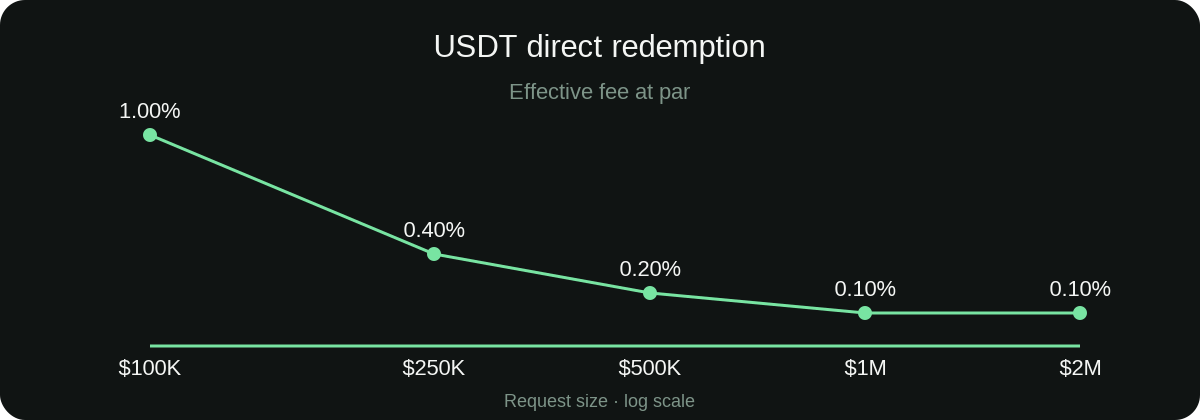
Tether’s direct fee schedule lists a minimum acquisition or redemption amount of $100,000 and a redemption charge equal to the greater of $1,000 or 0.1%. Its information document describes eligibility for verified customers. The numbers below apply the stated redemption charge to otherwise qualifying requests at par. They exclude verification, banking, network and any other applicable costs. Tether fee schedule · Tether International information document
| Eligible request at par | Fee under the published schedule | Net after the redemption fee | Implied net per USDT |
|---|---|---|---|
| 100,000 USDT | $1,000 | $99,000 | $0.9900 |
| 250,000 USDT | $1,000 | $249,000 | $0.9960 |
| 1,000,000 USDT | $1,000 | $999,000 | $0.9990 |
At 100,000 USDT, the November 23 reference would equate to $99,908.80 before trading and withdrawal costs. That comparison is arithmetic, with no assumption of filling an order at the CoinGecko close. Check actual bids for the size you want and every cost of the fiat leg. A higher headline quote can leave less net cash if the available fees or slippage are larger.
What the Q3 report says about the issuer
Tether International’s September 30 Financial Figures and Reserves Report, published October 30 with a BDO assurance report, states about $191.45 billion of assets, $183.50 billion of total liabilities, and a difference of $7.95 billion. Approximately $183.47 billion of those liabilities relate to digital tokens issued. These are the issuer’s reported figures at that date. When tracking the buffer, keep liabilities and token-related liabilities distinct and read the composition table to see what kinds of assets contribute to coverage. Tether’s Q3 release · September 30 report and independent assurance
If a headline compares one quarter’s reserves with today’s estimated market capitalization, look up the matching liabilities in the same report. Market capitalization is an aggregate price-and-supply estimate. The report classifies liabilities under its own accounting framework. Comparing the two across different dates can create a misleading surplus or shortfall. The amount at a quarter-end also cannot tell you whether a particular transfer route is open right now.
Read a discount in the context of your chain and currency
A temporary discount on a specific chain can reflect limited inventory, trading interruptions or difficult withdrawals. Check whether you hold the issuer-recognized token and whether the destination actually accepts it. Older guides can mention networks on which minting or support changed. Use current issuer and destination documentation. A short-lived local discount gives different information from a broad discount accompanied by longer processing or changes in reserve disclosures. Tether’s past blockchain support transition · TRON’s separate resource economics
What cash availability would matter in a large redemption wave?
Tether’s October release put direct and indirect Treasury bill holdings at about $132.4 billion. The underlying report is more useful when testing which asset categories the issuer can turn into cash and how quickly. Direct Treasury bills and other exposures can have different settlement paths. At the same time, a separate reserve category can change in market value without creating immediately available cash. Use the report’s own definitions and note the date. A published asset mix does not establish what can be paid out through a bank at every hour. Tether’s Q3 release and reserve report
To assess a weak USDT quote, compare markets that settle in different quote currencies. If USDT and another dollar token both move against bank dollars, a pair between the two can look unchanged. For a second check, compare one direct USD route and one stablecoin route using the same trade size. Record if one market closes or suspends transfers before your transaction arrives. A quoted spread on a venue too far from the tokens in your wallet cannot serve as an immediate exit.
Finally, follow the disclosed fee schedule over time. Under the cited terms the crossover at which 0.1% reaches $1,000 is $1 million. Above that size the proportional fee remains 0.1%, before other charges. If the policy changes, update the table’s crossing point and the corresponding net bid threshold. Keeping an actual formula in the price forecast makes future updates auditable. This matters because even a small fee change can alter the more favorable route without a change in USDT’s $1 reference.
For the reserve section of your notes, retain the reporting entity’s name as well as the dates. Several products can have related branding and distinct terms. Reserve balances for another product should not be carried over simply because the units are quoted in the same currency. When comparing volume, keep issuer-side redemptions distinct from volume traded between market participants.
Frequently asked questions
Do I have to use Tether’s direct redemption if I only hold a few hundred USDT? Compare services available for that amount. A spot sale or platform conversion may be available under different terms and charges than the issuer’s direct route.
Does a USDT/USD trade change Tether’s outstanding liabilities? A secondary-market trade transfers tokens between participants. A mint or redemption affects issuer-side supply and is a separate event.
Should I compare USDT to USDG using the same exit fees? Use the actual policy of the issuer or venue you can access. The two assets can have different minimums and direct-access conditions. USDG’s redemption comparison