 Coin Price Analysis
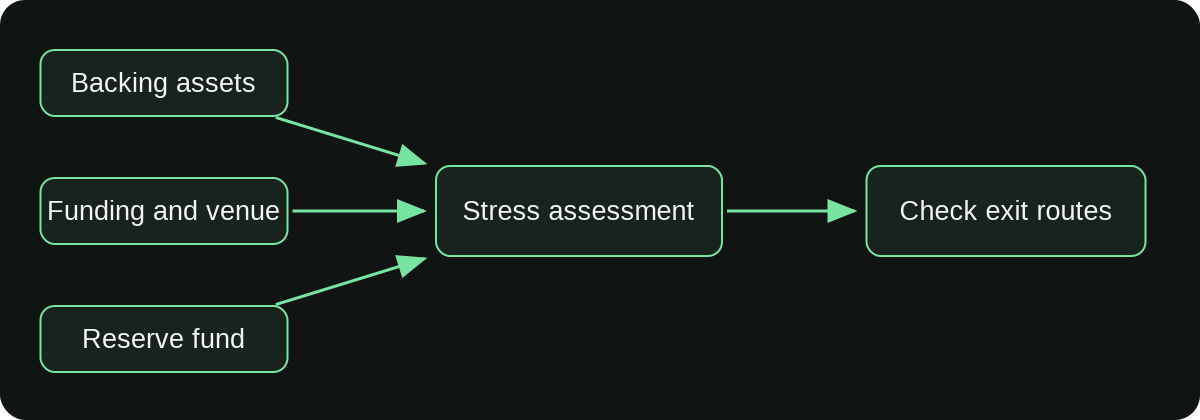
USDe’s working 2027 price reference is around $1 while the backing, hedges and available exits function as intended. CoinGecko’s November 23, 2026 UTC close was $0.999652, about 3.5 basis points below $1. A small deviation tells you what the aggregate quote looked like that day. The forward-looking question is how the design holds up if several sources of liquidity come under stress at once. CoinGecko USDe history · Ethena’s protocol overview
Test the backing according to what it contains
Ethena’s design combines assets that can be hedged using futures with other backing such as liquid stablecoins. A short hedge can reduce the effect of moves in the price of the underlying spot asset. That leaves exposures related to funding, execution, margin, venues, custody and the characteristics of other backing positions. Read the composition before assuming all backing behaves the same way when a market moves. Ethena overview · Ethena’s custodian-attestation documentation
An October governance review posted on November 17 placed month-end supply near $4.51 billion, down from about $4.87 billion at the beginning of October. It described roughly $2.23 billion in combined DeFi and institutional lending backing and $658 million in crypto basis positions at month end. These are dated observations from the report. They show why a current risk review should start with the actual asset mix. Applying a futures funding-rate assumption to the entire reported supply would treat unlike exposures as if they were identical. October governance review
Separate funding costs from a custody or execution problem
The reserve fund is designed as an additional buffer, including for adverse funding periods. A brief move to negative perpetual funding can raise costs for a short position. Repeated losses on a large hedge or delays in adjusting positions can have different effects. When reviewing a stress scenario, identify the position size, duration, other income and whether funds supporting the trade can be mobilized in time. Ethena reserve fund explanation
The November governance review distinguishes about $8.8 million of unrealized exchange-related profit-and-loss exposure reported after the late-October incident from a realized loss, and describes use of off-exchange custodians. A custody structure can reduce some risks while leaving settlement or profit-and-loss exposure to a venue. Use the latest attestations and reserve information to revisit those amounts, and keep exposures, losses and available buffer on separate lines. Ethena’s October governance review · HT Digital USDe reserve data feed
Follow the exit you can use
| What you observe | Which question it answers |
|---|---|
| A small discount in one pool | Does the pool have an inventory imbalance, or can a holder obtain a similar executable quote elsewhere? |
| Widespread discounts and falling depth | Which venues can take the amount, and are approved counterparties still processing redemptions? |
| A narrower reserve surplus or larger unsettled exposure | Which risks changed, over what period, and which assets are actually accessible? |
Ethena documents direct minting and redemption for approved counterparties subject to its requirements. A holder without that access can depend on a venue or pool, where the bid is affected by liquidity and the settlement asset. A dollar-denominated chart does not settle the question. If the pair is USDe/USDT and USDT is below par in the conversion market, account for both prices when calculating dollars received. Ethena’s guide to buying USDe · USDe mint user agreement
A fixed scenario helps estimate exposure without assigning probabilities. An exit at $0.995 on 10,000 USDe would yield $9,950 before fees, or $50 below par. An exit at $0.98 would yield $9,800. These are deliberately chosen stress inputs and say nothing about how likely a discount is. Record the loss on execution separately from delay. A liquid quote today can disappear before funds arrive, even if a trader ultimately has a usable venue.
If a reserve feed includes both backing and an additional reserve fund, record both measures. Comparing a combined figure with a backing-only figure from another date can produce a misleading improvement or decline. Check which positions the report could verify, when it measured them and whether the backing figure incorporates any profit or loss that has yet to settle. A snapshot is most useful alongside several comparable snapshots and a separate report about actual redemption activity.
For a hedge-specific sensitivity, test an adverse funding rate on the position it applies to and state whether the rate is per day, per funding interval or annualized. Funding charges can arrive at a different time from income elsewhere in the portfolio. When both the direction of the rate and the position size can change, use a range of durations and specify those inputs. This helps identify whether the main concern is periodic expense or a larger liquidity event.
A 2027 monitor can record three different timestamps for the same day: the market quote, the reserve observation and the time an approved exit was actually quoted. Keep them visible when you compare records. If the market looks stable while the other records have become stale, the available evidence is narrower than it appears. The same process can expose a local market problem when reserve and redemption records continue to look normal.
Frequently asked questions
Can USDe trade close to $1 while sUSDe’s reported yield falls? Yes. The USDe market quote and sUSDe’s rewards depend on different measurements. Check yield and the dollar peg independently.
Is an ENA governance vote a direct change to USDe’s price target? Assess the approved mechanism and what actually changed. A policy decision about ENA does not by itself alter the expected USD reference for USDe.
Does a supply contraction prove the peg failed? Supply can contract through orderly redemption. Compare changes in the amount outstanding with price deviations, actual liquidity and evidence of whether exits continued to function.