 Coin Price Analysis
RLUSD’s 2027 price reference is $1, assuming reserves, direct redemption and secondary conversions remain operational. CoinGecko recorded $0.999967 on November 23, 2026 UTC, roughly 0.33 basis points below par. For someone moving money, the bigger question is whether their wallet, blockchain and venue support an end-to-end route for the balance. CoinGecko RLUSD price history · Ripple’s RLUSD terms
Read the issuer numbers and venue quote on different dates
Ripple’s transparency page showed $2,819.2 million of circulating RLUSD and $2,963.5 million of reserve funds as of November 19, 2026. Dividing those rounded figures yields about 105.1%. This is a ratio calculated from the issuer’s dated public balance figures. The page also describes monthly third-party attestations, which have their own measurement dates and scope. The November 23 close is a separate market reading. Neither observation should be used to fill missing data in the other. Ripple’s reserve and attestation page
Ripple’s user terms, updated November 16, describe how reserve value is measured on business days and set out the rights and responsibilities applicable to users. If another document describes which entity serves as issuer or collateral trustee, read it alongside the terms currently applicable to your account. A reserve update can help establish the stated backing. A venue’s terms determine whether its customer can use the venue’s conversion and withdrawal route. November 16 RLUSD terms
A route through Coinbase is different from a direct issuer account
Ripple’s October 28 announcement described RLUSD access through Coinbase platforms, together with support across XRPL, Base and Ethereum and conversion from dollars or supported stablecoins. An announcement establishes the service and stated scope. In practice, confirm that your location, account and market support the intended chain and function. Ripple’s documentation separately describes direct customers as approved enterprises or institutions. A retail exchange account does not by itself confer direct issuer access. Ripple’s Coinbase announcement · Ripple’s direct buy and redeem overview
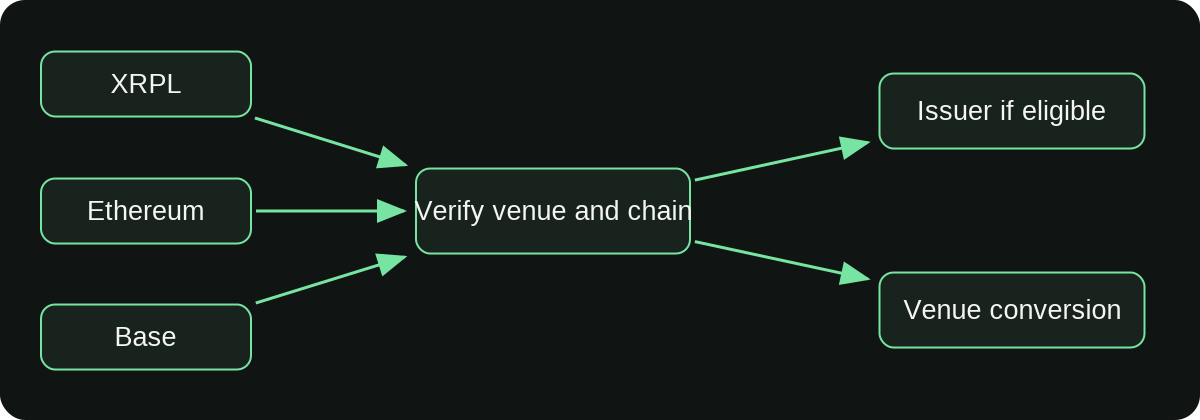
| Where the balance sits | Verify before comparing proceeds |
|---|---|
| XRPL self-custody | Confirm the official issuer and whether a receiving address is prepared to accept the issued asset, including an applicable trust line. |
| Ethereum or Base | Confirm the official contract for that network and whether the destination supports deposits and withdrawals there. |
| Platform balance | Check supported conversions, fiat withdrawals, settlement currency and any limits on your account. |
A currency symbol can look identical across networks while deposit requirements differ. On XRPL, Ripple describes trust-line setup for self-custody and specific destination tag requirements for some omnibus transfers. On supported EVM networks, identify the published contract and make sure the venue supports it. If an address or network and asset combination is uncertain, obtain confirmation from the receiving service before counting that route as usable. Ripple’s XRPL implementation · Ripple’s redemption instructions · Official token addresses
What would make a 2027 discount more meaningful?
A local discount calls for checking the same size across several reachable markets. A persistent gap across several routes is stronger evidence of broader stress, particularly if it coincides with delays at the issuer or another material change. For a useful record, write down the date, blockchain, order size, quote currency, estimated execution price and fees. Keep an operational delay distinct from an outright change in the sale price.
The normal case remains a quote near $1. Additional networks and venues can improve access when routes stay liquid, but can also fragment liquidity. Compare actual proceeds rather than counting supported chains. For example, a one-cent difference on 10,000 RLUSD would change proceeds by $100 before fees. A small per-token departure matters when the settlement amount is large. USD1’s separate issuer-versus-venue framework
For bookkeeping, keep four fields for an actual transfer: the origin chain, the token identifier, the receiving account’s instructions and the currency that arrives after conversion. A stablecoin may arrive correctly on-chain but remain uncredited by the platform if deposit requirements were not met. Where a venue requires a tag or an account-specific deposit address, take the requirements from the destination service. The recovery options vary by destination and are outside what a price chart can establish.
Compare the time between the issuer’s November 19 balance snapshot and the November 23 market close. Those dates are too far apart to compute a same-time deviation between market price and reserve coverage. To make a useful comparison, keep both records with their measurement time and check whether more recent reserve or issuer updates preceded the trade you are evaluating. A routinely updated website figure and a completed monthly assurance report should retain their own labels in your notes.
To distinguish a network-specific problem from a wider issue, hold the order size constant. Check an accessible venue on the affected chain and another route you can settle on. Identify any deposit, withdrawal or conversion limits before treating the second quote as an alternative. The comparison can show whether the immediate obstacle is moving the tokens, selling them, or withdrawing the resulting dollars.
Frequently asked questions
Does a rise in XRP increase the dollar target for RLUSD? RLUSD has its own issuer and redemption terms. XRP’s market price does not set RLUSD’s dollar target.
Does holding RLUSD pay me the yield earned by the backing assets? A promotional, lending or rewards product can have separate terms. The parity relationship and any extra return are different questions. Check who provides the reward and what eligibility or lockup applies.
Can I use a bridge quote as a measure of the peg? A bridge quote includes operational costs and may describe an asset arriving on another network. Compare a matched-size sale or qualifying redemption if the question is what dollars you can receive.