 Coin Price Analysis
United Stables targets $1 in 2027, subject to the ability to access its backing and process eligible redemptions. CoinGecko showed a completed close of $1.000 on November 22, 2026 UTC. Its November 23 row had no completed close in the dataset reviewed. The October reserve report provides a more specific question than a chart does. How much of the backing could the issuer access during a disruption at one institution? CoinGecko U price history · United Stables October assurance and reserves report
What the October report says, in numbers
The report was signed November 13, and its point-in-time measurement was October 31, 2026 UTC. It lists 1,606,644,735 U in circulation and $1,624,772,697 in reserve assets, for a reported surplus of $18,127,962 and 101.13% coverage. It also records $968,344,227 held in accounts at Binance on the reporting date, approximately 59.6% of the stated reserves. The balances covered stablecoins, a yield product and a small amount of cash. This concentration and coverage measure answer different questions. October assurance report, reserve table and Note 2
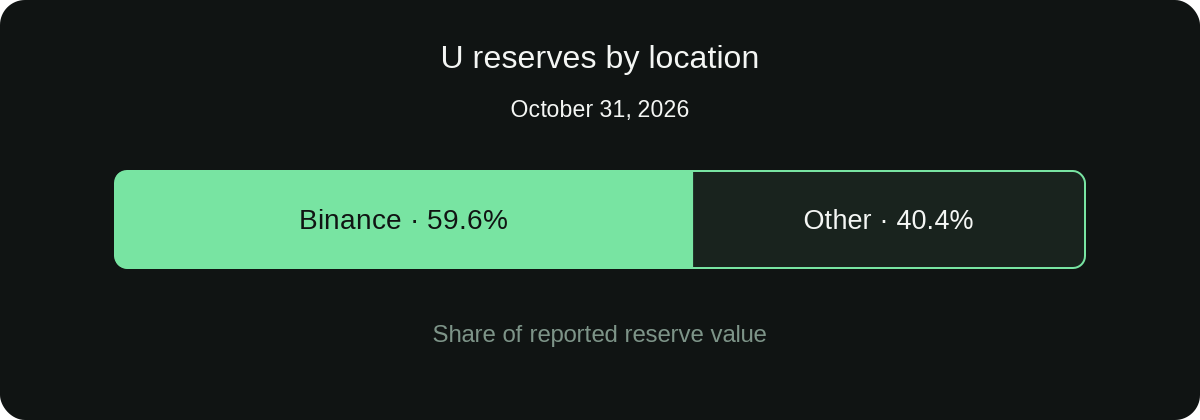
The same report says Binance withdrawals were suspended at the measurement date and resumed in phases from November 1. It describes a subsequently verified withdrawal of $50,000,500 in USDC from the issuer’s Binance position. The withdrawal is evidence that a specific amount was accessed later. The accountants’ report limits what can be concluded about remaining balances and timing. When one provider holds several types of backing, classify the assets by both what they hold and the venue or custodian that controls access. October assurance report, withdrawal evidence and scope
Run a reserve sensitivity with the disclosed numbers
Suppose, solely for stress testing, that a 2% value reduction applied to just the reported balance at that institution and that everything else stayed constant. The reduction would be about $19.37 million, roughly $1.24 million more than the stated reserve surplus. This was not a reported loss or an estimate of what will happen. It shows how an apparently small change in a concentrated position can be larger than a narrow overall margin.
A delay deserves a separate test. A balance temporarily unavailable for withdrawal is still a reported asset, while immediate redemptions may have to rely on the remainder. Test how much is available within your required time window. Then consider whether delays or price adjustments could apply to any eligible stablecoins or yield-bearing positions inside that remainder. The report values certain stablecoins and the yield product at the stated unit value and discusses the risks that valuation assumes. Coverage, liquidity by a deadline and exposure to each counterparty belong in different columns. October reserve report and valuation notes
What a holder can check in 2027
Start with U’s official terms. They describe onboarding and approval for direct mint and redemption access. If you hold through a venue, identify the reachable chain, deposit support and the asset you would receive when you sell. A trade producing a different stablecoin can expose you to that token’s separate market and exit conditions. An aggregate price near $1 may coexist with a worse quote for a large order on a specific chain. United Stables terms and conditions · United Stables whitepaper
The usual case is trading near $1 when reserve access and settlement are functioning. If a single pool becomes imbalanced, compare the executable bid on another reachable venue and the cost of getting there. If multiple markets show a sustained discount or an important route is unavailable, review current reserve disclosures and processing updates. Keep the evidence dated. The October concentration is a historical observation and should be replaced with a newer comparable disclosure when one is available.
The structure of the report also shows why a consolidated number can hide overlapping risk. The issuer described stablecoins, bank balances and units in funds or yield products. Some of the stablecoins were exchange-wrapped versions. Check what you would have to convert each instrument into before taking it out, because the withdrawal asset can differ from the reported backing category. A single exchange balance may bundle several exposures. The underlying assets may also share an issuer, custodian or settlement route. October reserves report, Note 2
To keep the concentration analysis current, preserve the total scope from one period to the next. Divide assets at each institution by all reported backing for the same timestamp. If an institution’s share falls, see whether assets were withdrawn, the backing grew elsewhere or the report reclassified holdings. The ratio alone does not identify which change occurred. Then examine any documented access tests. They are evidence about the amount and instrument actually withdrawn.
For a holder’s decision, compare the depth available on the chain where the tokens sit with the path to a better quoted market. A swap may produce a different stablecoin, and changing chains can add time and fees. A market that quotes $1 for a tiny quantity can still be expensive to use for a larger obligation.
Frequently asked questions
Does 101.13% coverage mean I can redeem U above $1? The ratio describes the reported assets per outstanding token at one point in time. It does not change the issuer’s stated redemption price or eligibility requirements.
What if my chain shows U at $1 but the trading pair is U/USDT? Check the USDT-to-USD rate and every route cost. A quote of one USDT per U need not give one dollar in cash after conversion.
Can I add the same U balance on its backing chain and its bridged representation? Verify the transfer and supply methodology first. A locked balance and the bridged representation it backs can represent the same economic exposure.