 Coin Price Analysis
USDC’s 2027 reference is $1 while banks, eligible Circle Mint redemptions and secondary markets remain operational. Its November 23, 2026 UTC close was $0.999632, around 3.7 basis points below par. The fact that a stablecoin traded close to target on one day cannot tell you what happens during a bank closure or a network-specific liquidity problem. CoinGecko USDC historical data · Circle USDC terms
What the March 2023 episode actually tested
Circle disclosed $3.3 billion of USDC cash reserves at Silicon Valley Bank in March 2023. Its March 13 release describes that reserve risk being removed following the authorities’ actions. Circle later reported that by the close of business on March 15 it had cleared substantially all of the minting and redemption backlog. It said it had redeemed $3.8 billion and minted $0.8 billion since Monday morning. Those updates show why a stablecoin’s exchange price can react to whether cash and conversion services can be accessed on time. Circle’s March 13 update · Circle’s operations update
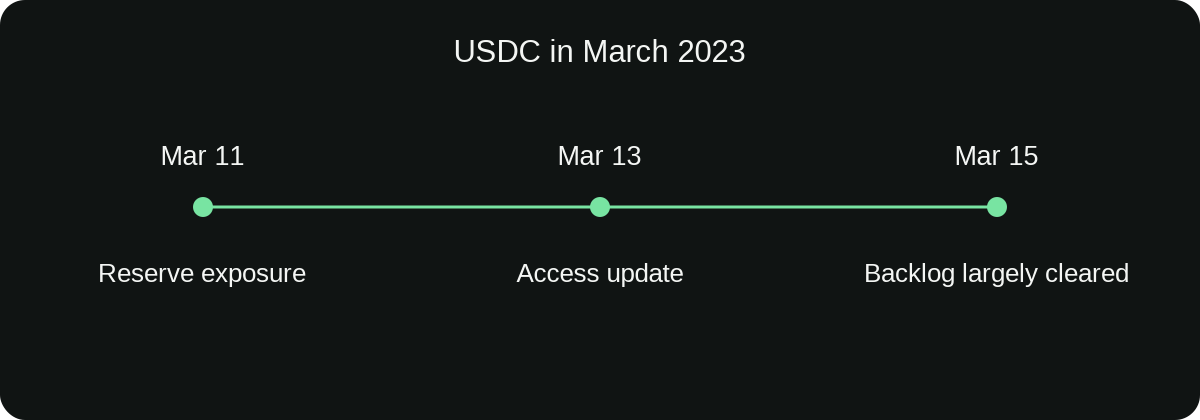
Use the history as a stress framework. Identify the reported backing amount and the fraction exposed to an operational restriction. Then check whether redeeming institutions can actually move cash and whether retail venues can offer bids at the needed size. A disruption can improve rapidly when services resume. A similar sequence is not assured for the next event, so retain separate dates for the underlying concern, recovery of service and normalized market quotes.
Read the 2026 sources at the right scope
Circle’s transparency page shows reserve categories that include bank deposits, overnight reverse Treasury repo and short-duration Treasuries. It distinguishes reserve reporting from issuance and redemption data. Use the November balance page for the date it states and the monthly report for the specific period and assertion it covers. To understand the reserve’s behavior under pressure, consider access to assets and cash settlement times in addition to the reported balance. Circle transparency and reserve composition
Circle’s terms distinguish direct redemption eligibility from general token holding. A holder may be able to sell USDC via a platform without personally having Circle Mint access. A venue conversion can have its own fees, limitations and release timing. Identify which step you control and which depends on a third party. The peg is easier to evaluate when the route and order size are explicit. Circle USDC terms and customer types · Circle Mint agreement
Native and bridged balances can have different exits
Check the token identifier and network, even if multiple assets appear as USDC in a wallet. Circle publishes separate terms for third-party bridged USDC and describes its own cross-chain transfer mechanism for supported native USDC. A third-party representation may require a bridge or an additional trade before you reach the issuer-compatible asset. Confirm what the receiving venue accepts before comparing quotes. Circle’s bridged USDC terms · Circle’s explanation of its native transfer route
For a three-step check, record a quote on the current chain, the expected amount after moving to a second chain, and the net dollars available after conversion or redemption. Include steps that can fail or take longer than your payment deadline permits. If only a particular bridged asset shows a persistent discount, investigate its bridge and available markets before drawing a conclusion about every native USDC market. If bids weaken across several otherwise independent routes, examine issuer updates and actual processing alongside market depth.
Which new routes improve access?
On November 18, Circle announced an expansion with DBS for eligible institutional clients in Asia, describing access to issuance and redemption with 24/7 settlement capabilities. That is evidence about the service and its stated scope. A holder without an eligible account should examine the actual retail route available to them. For comparing coverage, record the settlement asset, the service’s local conditions and any separate requirement to withdraw dollars after conversion. Circle’s November 18 DBS announcement
To build a useful stress comparison, put observations on a time axis. Record when a trading discount first appeared, whether redemption instructions changed, and when the accessible route restored normal processing. If the issuer reports that a backlog cleared, do not overwrite the original time to settlement for a transaction that was delayed. In a future event, compare the sequence rather than borrowing the March 2023 timeline as a prediction about how quickly a new event would clear.
Finally, assess the value of the route for a specific payment. At November 23’s aggregate price, 100,000 USDC has a reference value of $99,963.20 before costs. An actual sale could have different proceeds. A holder using an issuer-compatible route needs to account for the schedule on that route. Someone holding a bridged version also needs to account for the step that makes the asset usable. A calculated $36.80 reference gap and a delay of one day measure different exposures. Both matter if the money has to reach a recipient on time.
If you are tracking a large transfer, save both the network completion time and the timestamp when the receiving platform made the amount withdrawable. The gap helps explain why a technically successful transfer may still miss an operational cutoff.
Frequently asked questions
Does the reserve fund’s income add to my USDC balance? Holding the token and participating in an interest or rewards product are separate. Confirm any distinct agreement before counting a return.
Can a USDC price of $1 on a screen be rounded? Yes. A quote displayed to two decimal places can hide differences that matter at large sizes. Compare bids with enough precision for your settlement amount.
Why can two providers show a different USDC depeg low? They may measure different markets, time zones or price fields. A brief low and a daily close describe different events.