 Coin Price Analysis
SUN would need to gain about 83% from its November 23, 2026 UTC close of $0.01477166 to reach $0.027. Whether that is plausible depends on token demand for governance and the amount of protocol revenue that actually goes toward purchases and burns. Trading volume across all of SUN.io and income from eligible pools answer different questions. CoinGecko Sun Token historical data · SUN.io buyback and burn rules
Follow one documented fee route
The SUN.io documentation lists separate revenue contributions by product. One entry specifies one-sixth of fees accumulated by the TRX/USDT 0.05% pool on SunSwap V3, included since May 2, 2026. The cited share applies to that pool’s eligible fees. Applying the same ratio to every V3 swap would overstate the amount available under this rule. Start with the fee tier and pool before estimating the resulting purchase budget. SUN.io product-level buyback documentation
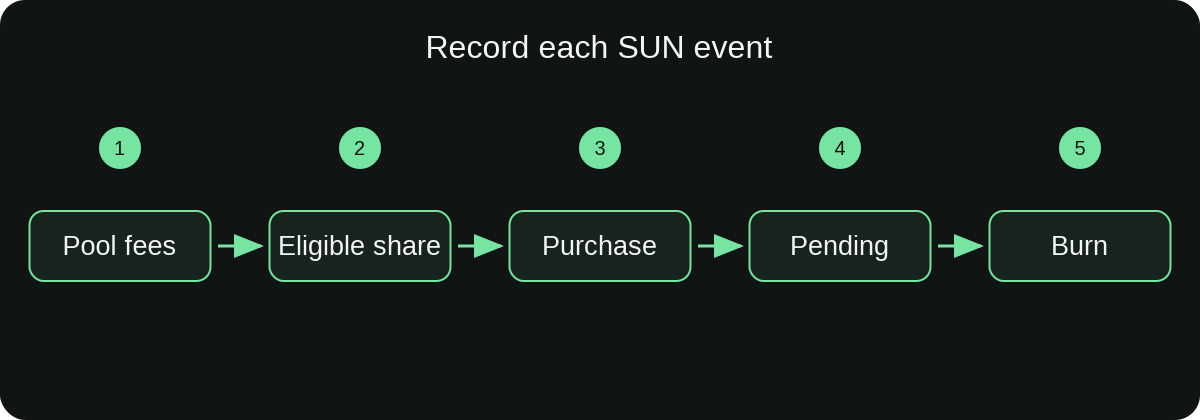
Capture three records when comparing quarters. Use the eligible fee amount, the purchase execution and the final destination of the SUN. The documentation describes a pending-burn address in the V3 route. Treat an amount pending removal separately from a recorded burn. A rise in pending balances can show progress in the process while leaving a gap between planned and completed reductions. An aggregate dashboard can also report different products at different times. Use a consistent cutoff for all stages.
What the November reward change means for veSUN
SUN.io’s November 19 notice said TUSD rewards for veSUN holders were discontinued on November 18 Singapore time. The protocol documents veSUN as voting power obtained by locking SUN. The reward notice affects a particular distribution. Evaluate future demand for those locked positions against the terms that actually apply, including relevant voting rights, remaining distributions and time to unlock. A headline yield from earlier in 2026 cannot substitute for this check. November TUSD distribution notice · veSUN vote-escrow overview
When tracking liquidity, use the SUN balance and calendar of potential unlocks separately from voting power. Two locks can produce different governance power because they have different durations. A change in the reported amount of voting power does not tell you how many units could reach a market on a specific date. For a supply comparison, keep locked balances and removed tokens as separate categories. SUN.io veSUN mechanics
Valuation at $0.009, $0.018 and $0.027
| SUN sensitivity | From $0.01477166 | Implied value at 19B SUN |
|---|---|---|
| $0.009 | −39% | $171 million |
| $0.018 | +22% | $342 million |
| $0.027 | +83% | $513 million |
The 19 billion input is rounded for the calculation. A new circulation estimate can change the final values. The low case captures weak fee-paying activity or lower interest in locking SUN. The middle case reflects a recovery with measurable fee routes. The higher level would need stronger, sustained demand and enough real liquidity for buyers and sellers to transact around a much larger valuation. The levels are sensitivity points with no assigned probabilities. CoinGecko SUN market data
For an observable update, record the named pools each month, their eligible income, SUN acquired and tokens permanently removed. Compare that with new tokens becoming available to trade and with real depth. Stronger trading activity can coexist with a change in which pairs receive incentives. Track the impact under the actual funding route. JUST’s separate lending-income and buyback analysis
Verify that a new product changes the same revenue stream
SUN.io’s project history dates the SunSwap V4 launch to March 2, 2026. The launch added a new architecture and a hooks mechanism. For the valuation, the key question is how the new usage is monetized and which part of it is directed toward token purchases. An application can report activity on V4 while a documented purchase rule belongs to a specific pool in V3. Estimate those flows independently. If traffic migrates, watch for a corresponding change in the earnings line you used for the forecast. SUN.io protocol and release overview
Spend one month comparing the pool’s fee base in its original denomination with the eventual amount of SUN obtained. The worth of the purchase budget in dollars and the number of SUN purchased may move differently with the price at execution. Use the date and the purchase record to reconcile the two. If a batch is sent for a pending burn at month-end, carry it as pending until you can link the later removal.
For a scale check, calculate net change in the relevant supply as units newly eligible to trade less verified units removed during the same window. Keep a separate line for temporary locks. Compare this result with fees generated by genuinely recurring activity instead of with turnover alone. If an active pair moves into a lower-fee route or uses a different token incentive, more trades may not mean more value going to the burn. Updating the assumptions pool by pool makes the outlook easier to audit.
As a check on a price narrative, compare the realized token purchases with the increase in units becoming available after locks expire. If the periods do not match, keep the figures separate until they can be reconciled. A one-day transfer to a pending wallet cannot stand in for a full-month removal figure.
Frequently asked questions
Can a new SUN lock lower the number of tokens immediately available to trade? It can constrain the holder under the applicable lock terms. An unlocked balance can return to circulation later.
Does the end of a TUSD reward change TrueUSD’s dollar target? The SUN.io notice concerns a distribution program. It does not set the redemption policy for another issuer’s stablecoin. TrueUSD’s separate peg analysis
Can fees in TRX be counted as SUN purchased? Record them as eligible fees until execution is established. The number of SUN acquired depends on the actual conversion.