 Coin Price Analysis
A $6 PIEVERSE price in 2027 would require a gain of about 68% from the November 23, 2026 UTC close of $3.57. That price means about $1.8 billion at a hypothetical 300 million circulating tokens, or $2.4 billion at 400 million. The case rests on whether paid agent activity creates demand specifically for PIEVERSE. Payments settled in pieUSD count as product use and must be traced further to establish a token effect. CoinGecko PIEVERSE price history · Pieverse whitepaper
Follow the payment asset through one transaction
The whitepaper describes x402b as an extension of the x402 protocol for payment flows, with pieUSD described as a wrapped USDT asset. It also lists separate uses for PIEVERSE, including governance, incentives, and discounted charges or subscriptions. That gives a researcher distinct questions to ask when a product announces an integration. What asset does the customer pay? Which asset does the service receive? Who has to acquire or lock PIEVERSE? The payment amount might be visible before either of the other two answers can be confirmed. Pieverse’s protocol and token sections
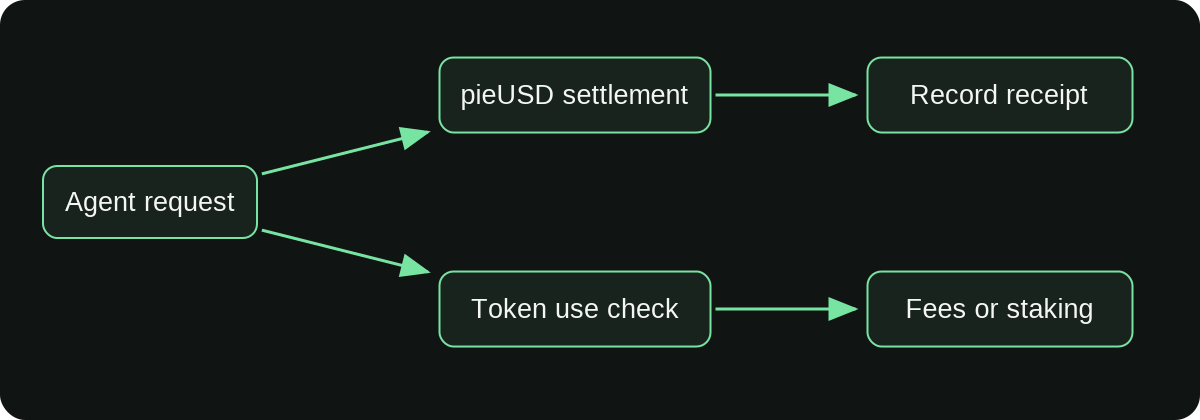
Use the project’s developer documentation to identify the product and the actions it supports. For instance, its agent wallet documentation describes sending tokens and checking balances. This establishes advertised functionality. It does not supply a public total for paid production usage. To test the valuation case, look for detailed records of settled requests, repeat paying buyers and fee or discount events that actually involve the token. Mark a test environment, a transaction funded as an incentive and a payment made by a returning commercial customer as distinct observations. Pieverse developer documentation
Fee schedules deserve their own line. A token discount can create a reason for a customer to buy PIEVERSE, but savings must exceed conversion and handling costs for customers to choose it consistently. If fee estimates are published, record the undiscounted rate, the currency and the size of the transaction. An optional use has more valuation weight once customers actually select it repeatedly.
For a basic merchant comparison, distinguish a payment request from a settled payment and a settled payment from a retained fee. One buyer can retry the same action several times, and a transaction can have an associated receipt as well as a settlement record. Count unique completed purchases rather than adding the two records together. If receipts are part of the service, keep optional receipt charges separate from payment fees. Pieverse’s whitepaper includes possible sources of revenue beyond transaction fees, including subscriptions. None should be entered as current recurring revenue unless the data establishes it. Pieverse revenue model
A useful independent check is whether a merchant’s payments continue after a discount or campaign ends. That provides information about customer demand, while recorded token purchases or locks show the separate token effect. A large one-off buyer can dominate totals, so track number of paying merchants alongside aggregate settlement.
Model circulation without relying on one unlock estimate
The whitepaper lists one billion total PIEVERSE, with allocations for investors, the community, the foundation, the ecosystem and the team. Contemporary provider snapshots can disagree about the amount considered circulating. The model uses 300 million and 400 million solely as simple comparison inputs. They are not a statement about the exact November float or December 2027 circulation. Pieverse allocation and vesting section · CoinGecko market data · CoinMarketCap market data
| 2027 stress point | Change from $3.57 | At 300M PIEVERSE | At 400M PIEVERSE |
|---|---|---|---|
| $1.75 | −51% | $525 million | $700 million |
| $4.00 | +12% | $1.20 billion | $1.60 billion |
| $6.00 | +68% | $1.80 billion | $2.40 billion |
At the same $1.2 billion valuation, an increase from 300 million to 400 million circulating tokens would imply a decline from $4 to $3 per token. That isolates the supply effect. A schedule is one input in that calculation. Track released balances separately from actual tender into the market and from assets remaining under the control of one holder.
Put November’s fast moves in context
CoinGecko’s reference series shows $3.68 on November 22 and $3.57 the next day, a decrease of about 3%. Its volume field was also much larger on the second observation. That combination tells you trading conditions changed, but a daily aggregate cannot identify who sold or prove why. For a current exit, record a venue-specific spot quote and the available depth for your amount. A derivatives quote or an exchange whose deposits are unavailable does not establish executable spot liquidity. CoinGecko PIEVERSE history
The higher-price scenario gets more credible if there is evidence that paid requests recur, token-specific uses register independently of stablecoin settlement and the market can handle more tradable supply. If most activity is funded by promotional rewards or the useful features work entirely without acquiring PIEVERSE, lower the weight you assign to product growth. A project can deliver a convenient payment flow without delivering proportional value to its token.
If an application keeps a transaction log and an independent settlement record, check whether the two can be matched without exposing customer details. A sample with reconciled counts and amounts is more informative than a dashboard that lists requests, receipts and payments in a single total.
Frequently asked questions
Does an on-chain receipt prove a service was delivered? It can document a payment or timestamped record. Whether a service was delivered as agreed depends on what was recorded and the underlying transaction or agreement.
Can transfers between BNB Chain and Ethereum inflate the supply estimate? They can distort a naïve tally. Reconcile the official contracts and bridge accounting before adding balances across networks.
Does high agent transaction count always mean growing revenue? No. Count settled payments and the fees charged for them. A high number of tiny or subsidized requests can have a very different revenue profile from recurring commercial activity. Kite’s separate agent-payments outlook