 Coin Price Analysis
KITE would need a gain of about 29% from its November 23, 2026 UTC close of $0.140036 to reach $0.18. The strongest evidence for that case would connect production usage to actions requiring KITE. More payments in a test environment, on a different chain or through a stablecoin wallet can be evidence of a useful product, while the connection to KITE’s value still needs to be demonstrated. CoinGecko KITE price history · Kite’s November 2026 MiCA whitepaper
Read the November release at the product level
Kite published a November 18 release note stating that Kite Chain was removed from the Passport product’s supported chains. The listed changes covered Passport deposits, sending, payment and balance displays. This matters for any forecast that uses the number of Passport transactions as a proxy for Kite Chain activity. A change to Passport support has a narrower scope than a change to the entire blockchain. Kite maintains a separate mainnet reference. Its November 19 release note describes features including a Base swap route, another reminder to log where the product routes transactions. Kite’s November 18 release notes · Kite’s release history · Kite mainnet documentation
The November MiCA whitepaper also reflects a migration of the Ethereum KITE token contract to a replacement deployed on August 12, 2026. If you use contract-level volumes or holder data, identify which address the data covers. An old token balance can remain visible and a migration can produce a large transfer without the underlying owner selling anything. Count legacy and replacement balances with a documented method before you infer a new supply event. Kite’s token whitepaper and migration fields
Use the asset required at each step
The whitepaper describes a stablecoin-based gas model as well as KITE uses in staking, rewards and certain activity involving agents and services. Those are separate demand pathways. For example, a published stablecoin-gas integration explains what payment can work. It does not give evidence that an agent purchases KITE every time it makes a request. A stronger signal would be an increase in required staking or another documented, repeated token action that follows from the service’s rules. Kite developer tokenomics · Stablecoin transfer integration guide
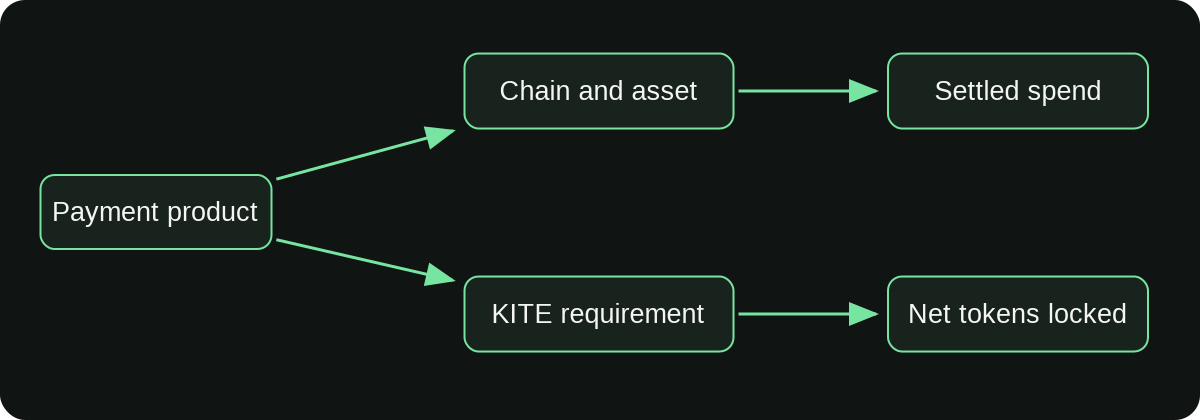
Build an attribution record for one use case. Record the wallet product, chain, settlement asset, fee asset and who paid the fee. Then identify any mandatory KITE holding, amount locked and release conditions. Record net changes over time if the data exists. If KITE is distributed as rewards, identify the source of those tokens separately from any user demand. A reward budget can boost usage and add circulating balances in the same period.
Budget limits, transaction counts and settled spend measure different things. A payment session can authorize a maximum amount while the agent actually spends much less. A good monthly comparison uses completed transfers and net spend after failed or reversed attempts where those records exist. If a dashboard only counts sessions, label it as a measure of product activity. The total authorized budget cannot tell you the amount of fees collected.
The mainnet documents and Passport release notes serve different purposes. For a version-specific claim, write down which product and version were observed and then record which chains were available on that date. If a new route uses a different chain, look for an explicitly documented fee or token obligation before assigning it to Kite Chain. Checking this boundary matters more than counting every route that carries the Kite name.
Market data providers may also exclude different balances from their definitions of circulating KITE. If a published release schedule and the aggregator disagree, preserve both with dates and explain why you chose one as the baseline. Token migrations, treasury restrictions and rewards can produce a difference even when both sources are measuring consistently under their own definitions.
Stress-test both price and circulation
Use 2.5 billion and 4 billion KITE as rounded sensitivity inputs. They represent different circulation assumptions, with neither entered as a consensus estimate. Use the market provider’s dated figure or a reconciled chain-level series to update the inputs. Kite tokenomics · CoinGecko KITE market data
| 2027 KITE stress point | Change from $0.140036 | At 2.5B circulating | At 4B circulating |
|---|---|---|---|
| $0.075 | −46% | $187.5 million | $300 million |
| $0.18 | +29% | $450 million | $720 million |
| $0.30 | +114% | $750 million | $1.20 billion |
A $450 million valuation would imply $0.18 at 2.5 billion or $0.1125 at 4 billion. That is the sensitivity to supply at a fixed valuation. A stronger outlook would need both repeat token-specific activity and enough demand to support the resulting valuation at the applicable supply. If adoption grows mainly on other chains and the token link remains unmeasured, assign it less weight. Use an actual order quote to assess market depth before assuming that a short spike can support a larger order.
If a KITE requirement applies only to a provider, compare the provider balance it must keep with the fees its users pay. A service can handle many customer payments while maintaining a largely unchanged stake. The token exposure comes from the required balance and how that balance adjusts when providers join or leave.
Frequently asked questions
Is KITE the same as a token whose ticker is KITEAI? Check the issuer’s named networks and token identifiers. Similar tickers can point to unrelated assets with different supply and prices.
Can a migrated token still show a price on a chart? Yes. An aggregator or market can continue showing a legacy instrument. Check which contract and trade route are available before using the quote in your model.
What if the number of agents increases while their spending stays flat? That can indicate more onboarding with lower spending per agent. Track paid and recurring activity to see whether economic use is expanding. Pieverse’s related payments test