 Coin Price Analysis
EURC’s 2027 price target is €1. Its U.S. dollar price can rise or fall when the euro moves even if the peg in euros holds. CoinPaprika reported a $1.0901 daily close on November 23, 2026. The European Central Bank’s reference rate that day was $1.0939 per euro. The readings come from different sources and times, so their difference illustrates a comparison to investigate rather than a confirmed peg deviation. CoinPaprika EURC daily prices · ECB November 23 euro reference rates · Circle’s EURC overview
Separate the euro position from the token discount
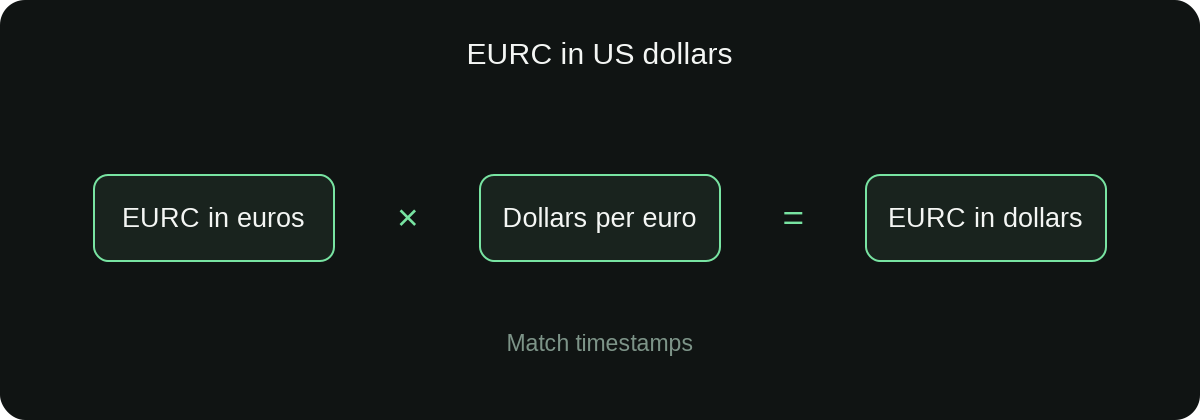
When pricing EURC in dollars, first obtain a comparable EUR/USD rate. Next measure what a EURC trades for in euros or the equivalent through a USD pair. At a matching time, dividing the dollar bid for EURC by the dollars per euro yields an implied quote in euros. Using the two figures above mechanically gives about €0.9965. Because they are unsynchronized and the ECB rate is a reference, this amount does not establish a real €0.9965 exit. A dollar chart by itself cannot tell you how much of a move comes from foreign exchange.
| Illustrative EUR/USD level | EURC at exact euro par | EURC at an illustrative 0.5% euro discount |
|---|---|---|
| $1.00 per euro | $1.0000 | $0.9950 |
| $1.10 per euro | $1.1000 | $1.0945 |
| $1.20 per euro | $1.2000 | $1.1940 |
These figures are exchange-rate sensitivities, with no implied likelihood. At the same euro price, the USD figure moves directly with EUR/USD. At the same EUR/USD rate, a widening token discount reduces the USD and euro values together. Label which variable changed when revising the forecast. Do not infer that EURC strengthens against the euro just because it rises against the dollar.
Check the way your balance becomes spendable
Circle describes EURC as backed in euros and redeemable one-to-one for euro, subject to the relevant arrangements. Eligible institutional paths and a retail sale on an exchange have different terms. If the intended payout is euros, check whether the service delivers euros directly or provides a stablecoin requiring a second conversion. If the payout is dollars, compare the currency conversion and transfer costs separately. Circle’s EURC overview · Circle’s reserve and transparency page
Chain availability matters as well. Circle publishes the networks on which EURC is natively supported. A destination can support the token on one chain without accepting it on the chain where you hold it. Determine whether your venue recognizes the exact token and whether the path can be completed in time. A good FX price cannot compensate for a route that fails to credit your balance.
Compare two amounts that reach the same currency
Take an illustrative holding of 10,000 EURC. Use the amount actually quoted for your size, then convert it into the recipient’s currency. Compare it with the par conversion route only if you can access that route. A stable EURC/EUR rate can coexist with changing dollar proceeds, while a constant dollar quote can hide offsetting movements. When the recipient needs euro, start with a euro amount and then compare fees. When the recipient needs USD, show how the FX rate and token discount contribute separately.
For ongoing monitoring, collect same-time bid and ask records for EURC and a reliable EUR/USD comparison. A gap seen only during a thin session may disappear when liquidity returns. A persistent euro discount across multiple executable routes deserves a separate look at market access and redemption. Preserve the timestamp and denomination so an intraday price and a business-day reference rate are never mistaken for one precisely matched observation. USD Coin’s dollar-based peg and redemption analysis
Measure the currency risk over the same payment window
Consider a merchant expecting to convert proceeds after a weekend. Suppose the merchant has 10,000 EURC, token conversion stays at euro par, and the available exchange rate shifts from $1.10 to $1.08 per euro before the payout. The implied gross USD value changes from $11,000 to $10,800. The $200 difference comes from the euro’s assumed move alone. If a 0.5% token discount also appears at $1.08 per euro, the illustrative gross amount becomes $10,746. That adds a separate $54 effect. These are reproducible sensitivities, not observed market shifts.
This is why an exchange rate sourced once a day needs a timestamp. The ECB reference rate is useful for benchmarking, but a market may be quoting prices before or after that observation. Compare EURC’s euro bid with the dollars you can actually obtain, including any intermediate conversion. If the two appear inconsistent, first check whether the same amount is available and whether the desk’s currency quote was live. A gap from asynchronous observations can be a data problem rather than something you could have traded. ECB reference-rate methodology and rates
For an updated 2027 view, distinguish the currency rate assumed for a business plan from the issuer’s euro settlement terms. Currency views can change while those terms stay the same. If an issuer or venue changes its supported network, record the access effect independently from the euro’s movement.
Frequently asked questions
Could EURC trade below US$1 and still hold its peg? Yes. If one euro is worth less than one U.S. dollar, a token trading around €1 can also trade below US$1.
Is a EURC/USDC pair exactly the same as EUR/USD? Both tokens can have market deviations and trading costs. The resulting pair is useful only with its own liquidity and currency assumptions.
Does the ECB reference rate guarantee conversions at that price? It is a reference rate published for information. Compare the executable exchange or provider offer separately.