 Coin Price Analysis
ETHFI would need to gain about 104% from its November 23, 2026 UTC close of $0.489048 to reach $1. With a rounded one billion token supply input, that would imply $1 billion in value. The recovery case depends on whether growth across restaking and consumer products produces measurable benefits or demand for ETHFI, including actual purchases under governance policy. CoinGecko ETHFI history · ether.fi governance resources
Product adoption and token adoption are different series
On November 12, the Optimism Foundation announced native xStocks minting and redemption for eligible users through ether.fi’s app on OP Mainnet. The announcement noted that earlier ether.fi support used a wrapped version. This is evidence of a product and settlement change. The announced catalog size measures the number of available products. To estimate whether ETHFI benefits, ask what fees the service retains and where those funds go. Optimism’s November 12 xStocks announcement
Follow one customer action. A user can obtain a stock-linked token, hold a liquid restaking position or stake ETHFI. The instruments grant different exposures. eETH and weETH reflect ether.fi’s staking products, while ETHFI has a governance role. The sETHFI documentation describes staking ETHFI and associated eligibility for program benefits. None of these structures makes product deposits a measurement of ETHFI purchases. For a clean quarterly comparison, keep balances deposited, net product fees and ETHFI-specific flows in separate columns. ether.fi’s resources for tokens and dashboards · sETHFI documentation
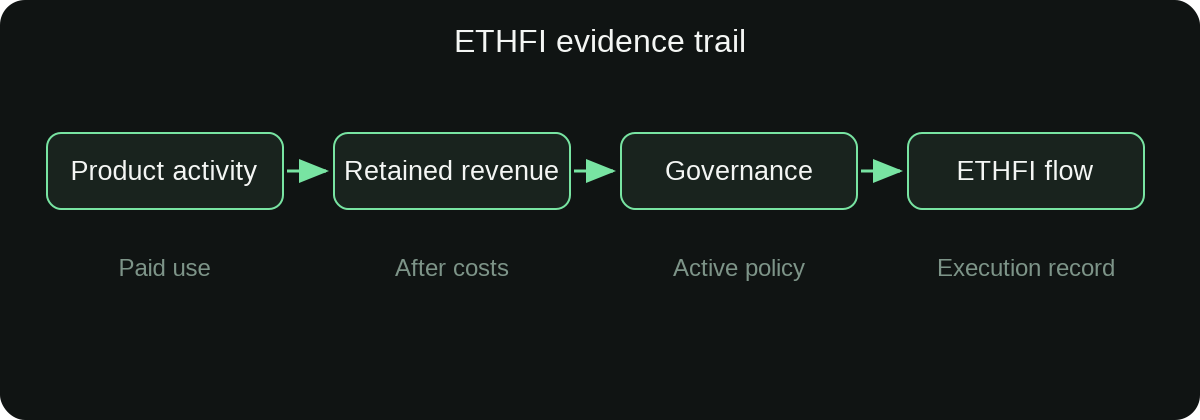
A buyback ceiling is the beginning of an audit trail
An October 2025 treasury proposal described buying ETHFI while the token traded below $3, up to $50 million. The numbers describe the proposal’s ceiling and conditions. They give neither a guaranteed price floor nor the amount the foundation subsequently spent. To measure execution, start with an approved decision applicable to the period and follow specific transactions. If the tokens were placed in treasury or used for rewards, document their destination. A buyback can reduce available supply for a time while leaving total supply unchanged. ether.fi treasury buyback proposal
Write down four fields for each period: gross fees, operating costs and incentives, revenue eligible for distribution or buybacks, and the final amount of ETHFI purchased. A source that publishes gross activity without expenses tells you more about scale than spending capacity. Similarly, a large cash balance does not establish that recurring fees can support the same purchases indefinitely.
If you compare with Ethereum’s own outlook, use the same dates to calculate both ETHFI/USD and ETHFI/ETH. This helps separate a broad rise in ETH-denominated assets from changes specific to the ether.fi token. A higher ratio is a market observation. Review the earnings and execution evidence to assess whether it reflects a durable change.
Put the $1 hurdle into perspective
| ETHFI year-end test | From $0.489048 | Implied value at 1B tokens |
|---|---|---|
| $0.30 | −39% | $300 million |
| $0.65 | +33% | $650 million |
| $1.00 | +104% | $1 billion |
The 1 billion input is used as a rounded scale test. For circulating market cap use a dated circulating figure. Avoid comparing the resulting full-supply-style value with another token’s circulating market cap. The $0.65 scenario would be easier to support if retained fees hold up and some ETHFI flows are measurable. The $1 test asks whether comparable growth persists when subsidies or launch attention fade. The lower scenario covers weaker usage, fewer buybacks or worse executable liquidity. CoinGecko ETHFI market data
For a later review, capture each product’s fee denomination and observation period. A stronger ETH price can lift dollar-denominated deposits or fee translations even when the amount of ETH customers provided barely changed. When the data permits, use both original units and dollars. Treat any buyback spending in cash as a separate quantity from the ETHFI acquired.
An update using product fees should separate one-time migration activity from normal use. If customers moved balances when a product added native minting, those transfers can support the technical claim that the route works. A better test for ongoing economics is how many positions opened or closed in comparable periods and which transactions generated a fee the protocol could retain. Do not multiply the catalog size by an assumed fee unless actual usage data supports that conversion.
Product fees may also go to parties outside the DAO, including partners or infrastructure providers. Identify the receiving address or the contractual arrangement when the source makes it available. If the seller retains only a share, use that share in the comparison and note whether it is before expenses. A buyback funded out of an existing treasury balance can happen in a period with stagnant fees. Keep treasury spending and recurring earnings in separate columns.
To check liquidity at the higher scenario, note whether the contemplated order is within visible depth and whether withdrawals work on the route you would use. An apparent recovery on a market with narrow access has a different impact for someone holding the token in a self-custody wallet. This practical difference can persist even if both readers see the same aggregate market cap.
Frequently asked questions
Does buying an xStock through ether.fi give me ETHFI? These are separate instruments. Read the transaction and any incentive terms before expecting a governance-token reward.
Does a collateral position in weETH track the ETHFI price? It has its own underlying exposure, rules and market price. An ETHFI rally gives no fixed change in the value of a weETH position.
Can I infer how much ETHFI was bought from changes in total spot volume? Spot volume contains many participants’ trades. Use published execution records or traceable transactions whose purpose and recipient can be established.