 Coin Price Analysis
DAI’s 2027 price reference remains $1. CoinGecko displayed a $1.000 close on November 23, 2026 UTC. Sky’s documented conversion from DAI to USDS gives eligible users a potential route out of DAI, but an exchange can change where it accepts DAI or which stablecoin it credits after a conversion. Those differences matter when estimating real proceeds. CoinGecko DAI history · Sky’s conversion information
Follow the route from DAI to dollars
Sky describes DAI-to-USDS conversion at one-to-one and documents a way back for eligible users. Its Peg Stability Module, or PSM, separately supports conversions between USDS and USDC. A holder who needs bank dollars may still need a conversion or redemption from USDC. Keep the route in order. The DAI-to-USDS exchange is a token conversion. The next leg depends on available inventory and the last leg on your account’s ability to receive fiat. Sky’s upgrade FAQ · Sky’s October 9 PSM guide
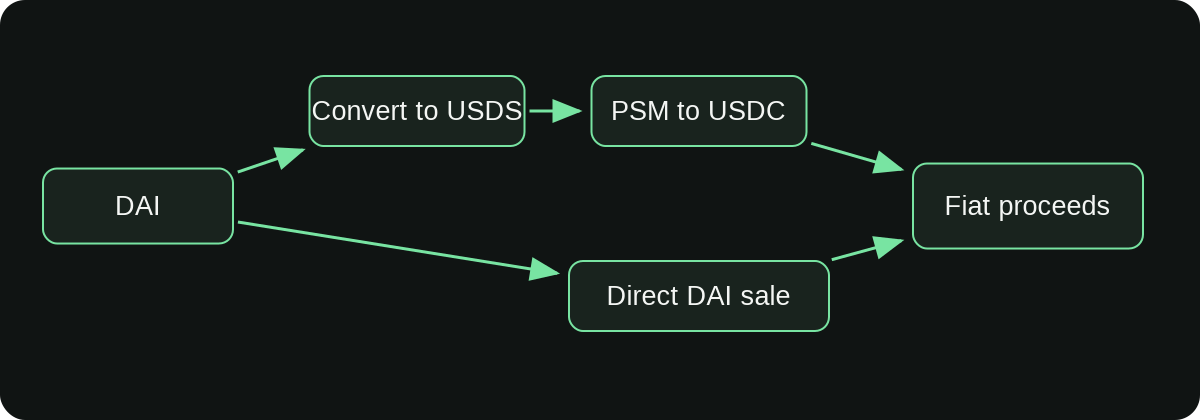
A simpler alternative can be a direct market sale of DAI. Compare expected fiat proceeds at the same order size after spreads, fees and any extra swap. Fees and slippage differ by route. A conversion that charges no protocol fee can still involve network costs or a later fee elsewhere. If the longer route is quoted close to par while the direct route is discounted, determine which can complete by the required settlement time.
Why a venue change can matter without a protocol change
Coinbase’s migration help describes a May 2026 one-for-one exchange of DAI for USDS for eligible balances and says it excluded specified EEA regions. A separate notice said Coinbase would convert remaining affected EEA stablecoin balances, including DAI, into USDC on October 30 at the applicable market rate. These notices describe Coinbase’s account policies for different holders. Neither establishes a change to the DAI contract or the one-to-one upgrade route. Coinbase token-migration notice · Coinbase EEA stablecoin notice
Sky’s governance records are useful for a different question. A November 5 executive proposal included finalizing the offboarding of GUSD and USDP PSMs. That is evidence of changes proposed for named legacy modules. For a 2027 route, identify the specific pair, contract and available liquidity, then check the proposal’s execution status when relevant. The existence of an old swap guide does not establish that the module still provides your intended conversion. Sky executive proposal archive
What would make an observed discount meaningful?
An isolated DAI discount may come from thin liquidity on one venue. If a wider gap persists, check whether the DAI-to-USDS leg is available, whether the USDS-to-USDC leg can serve the amount, and whether the USDC quote itself is close to a dollar. For example, 10,000 DAI through one-to-one token conversions would yield 10,000 USDC before applicable costs. At an illustrative $0.997 USDC exit, this maps to $9,970 before the remaining costs. The example isolates where a discount can enter the path.
When reading a DAI supply chart, keep conversions distinct from market sales. A migration can reduce the visible DAI balance and increase USDS without requiring that the holder sells for dollars. Likewise, a venue can stop quoting DAI while another route continues to work. A useful 2027 monitor captures both the concentration of executable DAI liquidity and the depth of the actual conversion path rather than drawing conclusions from supply movement alone. USDC’s separate reserve and redemption outlook
Reconcile conversion capacity at the size you need
If you hold the token in self-custody, start with a record of DAI on its current chain. Establish whether a route crosses into Ethereum and whether the receiving app supports that balance. Next, ask how much of the downstream stablecoin can be obtained in one transaction. A displayed one-to-one rate gives a price for a successful conversion. It provides no evidence that a larger amount fits within the relevant module’s limits or that the receiving venue can turn the result into cash on time. Sky’s conversion interface · Sky’s PSM guide
Compare a quoted price in the direct DAI market with the net proceeds of the longer path. Use the same quantity and timestamp. Set aside any route whose eligibility or network support cannot be confirmed. If the larger order needs more than one route, preserve the amount each route can handle rather than applying the best displayed rate to the entire balance. That simple check can reveal why a chart close near $1 coexists with a different cost for settlement.
For a longer-horizon review, save snapshots of how much DAI liquidity remains usable and how much USDS liquidity the intended route can access. A protocol upgrade can shift liquidity between symbols without making every old balance immediately hard to sell. Conversely, a market that still shows a DAI quote may no longer accept new deposits. For publication or bookkeeping, label this change as a route or venue change unless an execution record supports a claim about price or token supply.
Frequently asked questions
Do I automatically earn the Sky Savings Rate if my wallet holds DAI? A savings position is a separate product with its own rules. Check what your wallet actually holds before estimating any rewards. Sky’s savings-token overview
If a venue no longer accepts DAI deposits, does the DAI in my wallet disappear? The venue’s deposit policy and your on-chain balance are separate. Check alternate supported routes before making a transfer.
Should I compare DAI and USDS with their aggregate market caps to measure the exit cost? Use actual quotes for your amount. An outstanding supply measure is not an order book or the inventory of an available conversion module.