 Coin Price Analysis
AERO would need to rise about 103% from CoinGecko's November 23, 2026 UTC close of $0.418835 to reach $0.85. Its November 24 snapshot was $0.4190. The ticker has survived a contract change, so verify which token an exchange or data feed uses before comparing prices, supply or liquidity. A higher valuation would be easier to defend with steady fee income and a clear picture of emissions after the migration. CoinGecko Aerodrome historical series · Kraken Aero migration notice
Kraken's migration notice gives two different conversion ratios
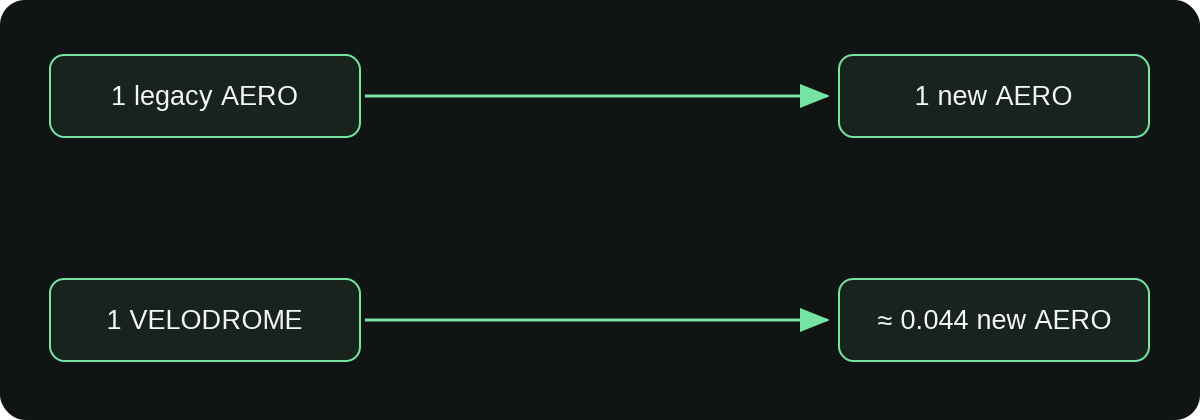
Kraken's notice, last updated November 5, described its migration window as November 2–6, 2026. It lists one legacy AERO for one new AERO on Base and approximately 0.044 new AERO for one VELODROME on OP Mainnet. It also says the new AERO retains the ticker and uses a different contract address. Those terms describe Kraken's route. For a wallet or different exchange, identify the current contract and route using the applicable official instructions. Kraken migration dates and ratios
To normalize a legacy quote for comparison, divide its price by the applicable number of new units received per old unit. If a VELODROME comparison uses the approximate 0.044 ratio, dividing a legacy quote by 0.044 expresses it per new AERO equivalent, before execution costs. At the same time, multiply the old token quantity by 0.044 for the converted balance. Keep the original quote if you are documenting what the old token actually traded at before migration. A theoretical conversion price describes the units in the calculation. It does not establish a quote the reader could have executed.
Reconcile three kinds of aggregate data
Price history, token balances and trading volume need their own migration checks. A continuous-looking chart may combine observations on both contracts. A supply dashboard may still list legacy outstanding balances and an equivalent quantity already migrated. A volume dashboard may count a conversion or liquidity movement even though it was not a new customer trade. Save the exact mapping or time boundary a provider uses before fitting a trend across the transition. Aerodrome Foundation's Aero migration FAQ
If a dashboard does not specify its contract filter, use the price as a historical reference and avoid drawing a circulating-supply conclusion from that chart alone. Compare total and unlocked balances using one well-defined source. For pool comparisons, use the fee rules and token contract active during the period. A chain split or contract replacement can create a break in a time series without a corresponding change in product demand. Aerodrome documentation
Check whether deeper pools can hold their users
Trading fees, emissions and voter incentives measure different parts of the system. To see whether a pool can hold demand, compare fee revenue under the same fee tier while checking what participants were paid in incentives. Look at whether traders and liquidity remain once a reward epoch ends. If total activity grew because the protocol covers more venues, consider both the aggregate and comparable pools. This distinguishes expanding coverage from higher activity in existing pools. Aerodrome documentation · PancakeSwap fee and emissions comparison
Use a three-epoch worksheet. Record fee expenditure, token incentives as quantities and average execution for a representative trade. Compare the fee figures at the same exchange-rate convention, and keep voter rewards separate from fees earned on the underlying trade. More trading activity can be attractive to liquidity providers while producing little additional value for the token if the costs of incentives increase at the same time.
What a $0.85 AERO price would imply
| 2027 AERO sensitivity | Change from $0.418835 | At 600M circulating AERO |
|---|---|---|
| $0.22 | −47% | $132 million |
| $0.50 | +19% | $300 million |
| $0.85 | +103% | $510 million |
The 600 million input is a rounded sensitivity. At 800 million, the same $510 million valuation would imply $0.6375 per AERO. The lower price tests weak post-migration demand and shallow depth. The middle case allows steady fees and orderly routing. The higher case would benefit from several periods of healthy fee-paying activity, more usable liquidity and a clear understanding of future token availability. CoinGecko AERO market data
What the first settled rewards can reveal
If a holder expects to receive any economic benefit from the migrated protocol, identify the required position. A freely transferable token, a liquidity position and a voting lock expose the holder to different things. The applicable network, withdrawal terms and observed fees or incentives matter to the realized result. Review the proof of the first distribution attributed to the new system and verify what funds it. A reward paid from new issuance should be kept distinct from fees users paid to trade. Use the published terms for the current epoch, since older documentation may apply to a different contract or mechanism.
For a market snapshot, collect quotes for the same trade amount across the relevant routes. Record which contract appears in the resulting settlement transaction and whether a price provider's observations come from the same market. A venue can continue quoting its internal market during a transfer pause. The price may therefore be usable for balances already on the venue while being unavailable to a wallet holder pending a supported deposit route.
A useful post-migration comparison has one consistent window for fees and emissions, and another check on whether the same liquidity is counted more than once when activity spans venues or chains. Track the fee-producing pool and the chain where trades settle. If two dashboards give different figures, compare their pool filters and the currency conversion before interpreting the difference as a major gain or loss in liquidity.
Frequently asked questions
Does every exchange use Kraken's migration dates? Each venue can choose its own windows and workflow. Check the announcement for the venue that holds the balance.
How can I identify an official migration route? Start from the exchange's support center or the project's verified resources. Match contract and network details before submitting an approval or transfer.
Can a holder assign the liquid AERO quote to a locked veAERO position? A locked position can have different transferability and voting rights. For a valuation, review the lock terms and the market, if any, for the position itself.