 Coin Price Analysis
SUI would need to rise about 48% from its November 23 UTC reference close of $0.673881 to reach $1. Hashi’s launch gives Sui a new way to attract Bitcoin-backed activity, but a $1 case also needs to explain how that activity translates into demand for SUI as more tokens enter circulation. Sui’s mainnet announcement confirms that Hashi launched. The next evidence to look for is recurring use and observable payment of network fees. CoinGecko SUI price history · Sui’s November 19 Hashi launch
Two ways to reach the same price
A $1 forecast means different things at different circulation levels. At 4 billion circulating SUI, it implies a market value of about $4 billion. At 5 billion, it implies $5 billion. Both amounts are useful round numbers for sensitivity, with 4 billion close to the scale in current market data. Neither input is a prediction for December 2027. Sui documents a long-run cap of 10 billion and publishes a proposed release schedule. The full cap is useful for showing fully diluted value while the market cap depends on what is in circulation. Sui’s official token supply schedule · CoinGecko SUI market data
| SUI year-end sensitivity | Change from $0.673881 | Value at 4B SUI | Value at 5B SUI |
|---|---|---|---|
| $0.40 | −41% | $1.60 billion | $2.00 billion |
| $1.00 | +48% | $4.00 billion | $5.00 billion |
| $1.50 | +123% | $6.00 billion | $7.50 billion |
The table makes two independent assumptions explicit. You can hold valuation fixed and ask how the price reacts to supply, or hold price fixed and see how much larger the valuation must be. For example, a $4 billion valuation with 5 billion circulating would imply $0.80. Track what the schedule releases separately from how recipients use those tokens. A transfer resolution or fresh release does not establish that the units entered a market order.
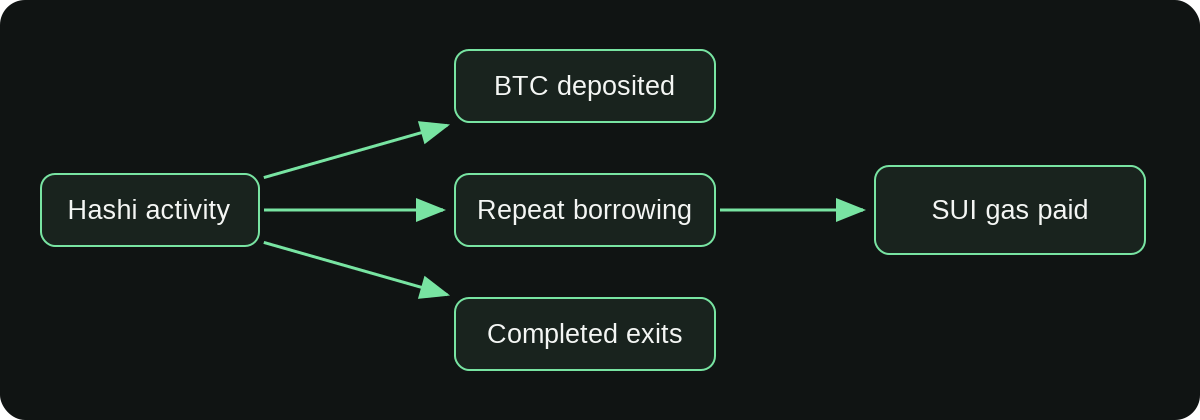
What Hashi has to prove beyond launch
Sui’s November 19 announcement describes live infrastructure, names participants and identifies custody, lending and vault use cases. The scope varies by participant. For example, BitGo was described as expected in 2027. Preserve the status of each integration when updating a forecast. Reporting a partner as expected does not establish that an end user can access its service today. Sui’s Hashi mainnet announcement
Follow a single activity through its lifecycle. Begin with a dated observation of BTC-related assets deposited in the application. Then check whether those assets sit idle, back outstanding loans or move through a vault strategy. Next identify the transactions that actually pay Sui network fees and the accounts that fund them. This allows a reader to separate an increase in asset balances from a change in how much SUI users or sponsors need. Remember that a BTC price move can raise the dollar value of deposits without adding any bitcoin. Comparing native units makes that distinction visible.
For a quarter-to-quarter comparison, use the same interval and keep deposits, outstanding positions and withdrawals on different lines. A redeposit could otherwise inflate the appearance of new capital. Watch what happens at exit as well. Custody, liquidity and a clearly documented withdrawal route affect whether institutions continue to use a product after a launch incentive expires.
A practical distinction between storage and supply
Sui’s tokenomics documentation separates computation, storage and staking. Part of the storage model involves a fund and rebates when eligible data is deleted. If the supply narrative depends on a storage balance, verify the mechanism and period. An amount held in a fund is different from an irrevocable reduction in the total number of tokens. Use the reported circulating measure and the official release schedule for your dilution check, then evaluate any storage claim separately. Sui tokenomics documentation
Prices in the cited series moved from $0.650495 on November 20 to $0.673881 on November 23, roughly 3.6%. That is a short observation after a product announcement. It cannot show which traders responded to Hashi or account for the broader market. An improvement in SUI’s 2027 case would require evidence of recurring economic use, a supply estimate you can reproduce and enough spot liquidity to execute in a market you can access. For another approach to evaluating BTC-linked ecosystem growth, see the RIF outlook. CoinGecko SUI price history
Define what would make you reduce the weight attached to Hashi. If deposited bitcoin stays high but open positions or repeat use fade, the launch may have brought a stock of assets without sustained activity. If borrowing grows while fees funded in SUI barely move, the stronger lending outcome can still have limited direct impact on the token. Either result can be recorded without assuming that the entire project succeeded or failed.
Count fees in SUI before converting them to dollars. A rising SUI price can lift reported dollar fees even if users or fee sponsors spend fewer native units. Also keep BTC withdrawn separate from the number of withdrawals, since the former captures size and the latter captures frequency. A few large customers can produce a rising total while other users stop returning. These measures can make the case for continued activity stronger or weaker without relying on address labels.
Frequently asked questions
Does depositing bitcoin into a Sui product give me SUI exposure? The product determines the assets you hold and the fees you incur. A bitcoin-linked position can retain BTC price exposure while adding custody, smart contract and exit risks.
Should I treat a position in a Hashi vault as cash available for immediate withdrawal? Check the vault’s documented redemption terms and available liquidity. The answer can differ between products and change when withdrawals are unusually heavy.
If an app sponsors gas, does the transaction still count as paid network activity? It can. Check the fee payer and recorded fee. A zero fee shown to the user can mean the sponsor covered the cost.