 Coin Price Analysis
STX would need to rise about 112% from its November 23, 2026 UTC close of $0.259818 to reach $0.55. CoinGecko's interim reading on November 24 was $0.2590. Bitcoin staking could support demand for STX where participation requires it, and sBTC could support activity across applications. The two mechanisms need separate checks before either is used to defend a 2027 price target. CoinGecko Stacks historical data · Stacks 2026 roadmap
The November milestone opens a distribution route
Stacks' roadmap lists BitGo's Bitcoin staking integration in November 2026. It also records an earlier milestone in which Bond 2 filled its 500 BTC capacity. BitGo's integration tells readers that an institutional custody route is available, and the bond result describes take-up at a specific capacity. Neither figure supplies the volume of BTC later brought by BitGo clients. To understand the opportunity, look for actual participation, active STX commitments and whether demand carries into new rounds. Stacks project milestones and dates
A bond that fills quickly can reflect limited capacity or a larger group of interested users. Comparing several rounds helps distinguish the possibilities. Use the offered capacity as the denominator. Compare BTC filled, STX committed, where publicly observable, and the duration of each commitment. Check when a previous commitment matures before adding all reported STX deposits to an estimate of coins removed from the freely tradable market.
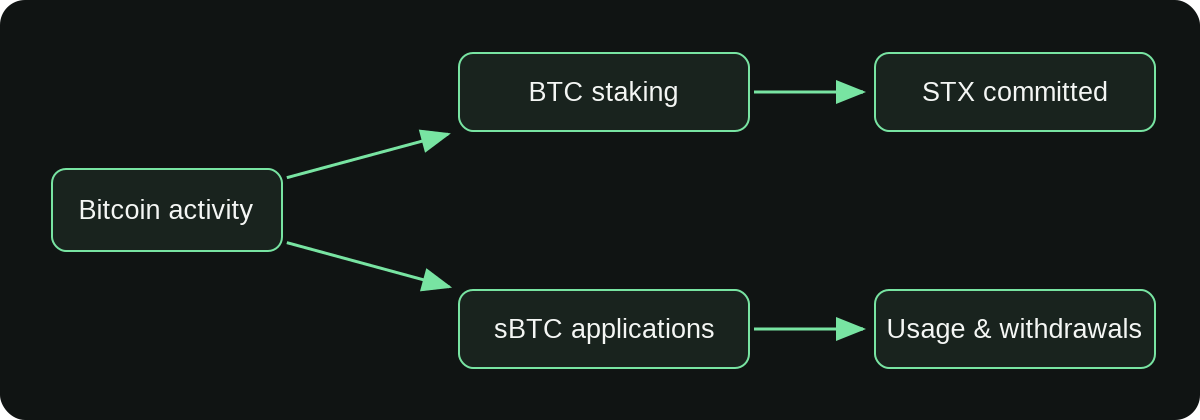
A BTC bond and sBTC answer different questions
Stacks describes its Bitcoin staking path as allowing BTC to stay on the Bitcoin base layer while STX is paired on Stacks. The same roadmap describes an open auction as part of future PoX-6 plans. Treat the current route and the planned protocol changes as separate pieces of evidence. Features that depend on a later activation deserve a fresh check of deployment status and terms before they appear as inputs in a pricing model. Stacks roadmap and planned upgrades
sBTC represents BTC on Stacks so applications can use it in smart contracts. In this case, watch deposits, actual usage in applications and withdrawals. A total supply observation gives useful context, but cannot establish how much is lent, used as collateral or left idle. The signer arrangements and the operational reliability of withdrawals matter independently of the dollar value deposited. Stacks documentation on sBTC
A routine comparison can follow a specific cohort across two periods. Does BTC committed through a round remain through later rounds, and does any increase in committed STX remain after earlier bonds expire? Do sBTC balances continue to move through several related applications? For the second question, avoid counting the same BTC equivalent twice when it is deposited into a position and appears again as a receipt or collateral token.
Translate the thesis into STX price levels
| 2027 STX sensitivity | Move from $0.259818 | At 1.95B circulating STX |
|---|---|---|
| $0.16 | −38% | $312 million |
| $0.33 | +27% | $643.5 million |
| $0.55 | +112% | $1.0725 billion |
The STX supply here is illustrative. At 2.05 billion STX, the same $1.0725 billion valuation would imply about $0.523. The $0.16 case captures the possibility that demand slows or much of the usage remains concentrated around limited events. A $0.33 level could fit ordinary growth and sustained access. The $0.55 case would be easier to support with continued BTC commitments, visible STX pairing and stronger evidence of application activity outside promotional windows. There are no assigned probabilities. CoinGecko STX market and supply reference
Watch STX priced in Bitcoin as well as dollars
If BTC appreciates, the dollar value of sBTC deposits can increase without a rise in the BTC units held in applications. The same market move can lift STX/USD while STX priced in BTC falls. Capture the dollar view and BTC view on the same dates. This makes it easier to identify whether a higher dollar price came alongside an improving relative valuation and whether more capital in native units actually flowed into Stacks.
Keep the measures tied to the economic question. BTC secured over a period helps describe participation. STX still committed after netting maturities relates to available supply. Network fees in STX show execution activity. A change in a single metric may be meaningful even when the other two move differently. Bitcoin price and benchmark context · Rootstock and Bitcoin DeFi comparison
Compare a filled bond with a renewal
Create a simple timeline with an opening date, close date, offered BTC capacity, occupied capacity and maturity. If the sources provide committed STX, note the amount beside the BTC observation, not as an additional BTC deposit. Then follow the maturity into the next reporting period. A round that remains fully occupied for its life shows one type of demand. Repeat participation after funds become available again gives more direct evidence of whether the commitment remains attractive under new terms.
When using published totals, ask whether the amount is active at the time of reporting or represents activity accumulated across older rounds. The difference changes an estimate of how much STX is temporarily out of the market. Compare a peak balance and a period-end balance if the source shows both. An analyst can report strong gross participation alongside limited growth in net active commitments. That distinction matters when deciding whether higher reported BTC interest has made STX materially scarcer.
Finally, attach a time convention to each input. Bond rounds can run on a schedule different from the UTC trading day used for the price anchor. Use a date range for a participation window and a timestamp for each market quote. This lets a reader compare future changes without mistaking differences in cutoffs for changes in participation.
Frequently asked questions
Does an STX spot position earn BTC automatically? Buying STX alone does not enroll a holder in a rewards activity. The specific route determines eligibility, timing and costs.
Why can the sBTC and BTC quotes differ? They trade in different markets. Liquidity, execution costs and withdrawal conditions can influence the price available in a particular transaction.
Does a reported dollar yield tell me how many BTC were earned? Converting a reward to dollars introduces a price input. Compare reward quantities in BTC over the same earning period when you want the change in native units.