 Coin Price Analysis
Stablechain's STABLE would need to gain about 116% from the verified November 22, 2026 UTC close of $0.02314181 to reach $0.05. CoinGecko's November 23 row for the relevant asset showed no completed close in the retrieved data. The valuation question is whether more settlement activity leads to a measurable need to hold or commit STABLE. Under the project's design, the network uses USDT as its native gas asset. CoinGecko Stablechain token history · Stable network white paper
Start with token identity and two separate roles
The project describes two broad roles. USDT is used as the gas asset and the primary settlement asset, with PYUSD also supported for settlement. STABLE serves roles in network security, governance and incentives under the project design. A user may make a payment without buying STABLE to pay gas. To estimate token demand, follow the mechanism that requires a balance or commitment and establish whether that mechanism is active. Stable white paper
A similar asset name can lead to the wrong history page. CoinGecko's separate listing at its unnumbered Stable URL shows another asset with a very different price and supply basis. For this forecast use the Stablechain listing associated with the project described above. Check project documentation, network and any required contract details before using a quote. For bridges or exchange deposits, confirm the exact supported representation with the service. Stablechain token listing · Separate same-name CoinGecko listing
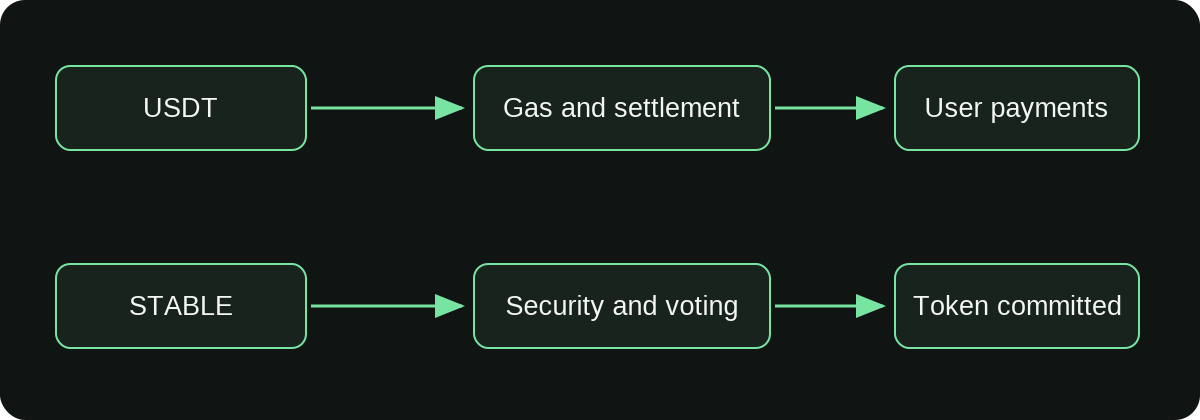
Trace a payment to its token effect
If a reported payment settles in USDT, check the sender, receiver and fees as separate operating observations. Aggregate stablecoin transfers can include exchanges rebalancing and funds moving across chains. For commercial adoption, look for completed transactions from identifiable applications over multiple reporting periods. Use an activity measure that can distinguish settled commerce or remittances from movements between accounts under common control where data permit. Tether USDT redemption and liquidity context
For STABLE exposure, the more direct question is what a validator, delegator or governance participant must hold or commit. Identify whether the relevant mechanism is active, what rewards are paid and when participants can withdraw. If rewards come from newly issued STABLE, keep their contribution to total units separate from any user-funded revenue. If the public records describe only a planned rule, keep that rule out of your current demand figures.
Flip the price case into a supply test
| 2027 STABLE scenario | Change from $0.02314181 | At 26B circulating STABLE |
|---|---|---|
| $0.012 | −48% | $312 million |
| $0.028 | +21% | $728 million |
| $0.050 | +116% | $1.30 billion |
The 26 billion denominator is illustrative. With $1.30 billion of value and 35 billion circulating tokens, the implied price falls to about $0.0371. The low case allows weak demand for commitments, greater availability or shallow spot bids. The middle case allows growth in real payment use and some visible need for STABLE. The higher case calls for repeated commercial use together with evidence that token commitments or other token-linked demand grow alongside it. CoinGecko Stable market and supply figures
The project's white paper specifies a 100 billion total supply and describes four allocation categories. The two 25% categories are team and investors or advisors. The team allocation alone therefore describes 25 billion units under the full supply plan. It does not establish the number becoming available in any specific month. At $0.05, multiplying by total supply gives a $5 billion fully diluted sensitivity, while the 26 billion circulation input above gives $1.3 billion. Specify which basis is in use when comparing tokens or interpreting the size of a 2027 move. Stable white paper allocation table
If a data provider changes the date or formula for circulation around an unlock, reconcile the previous figure with the new basis. Hold the assumed valuation steady when isolating the effect of the larger supply. Then make a separate decision about whether the observed demand is enough to support the original valuation estimate. This keeps the new units from being counted twice as both an arithmetic change and an assumed loss of demand without evidence.
Keep a release and a commitment ledger
Use a release calendar with cohort, announced date and amount. Then verify whether the release has executed and how the circulation provider treats the resulting balance. This allows you to distinguish an unlock becoming eligible from the behavior of wallets that received the tokens. For security commitments, track balances at the start and end of a comparable interval. A rise in gross commitments may coexist with little change in active balances once withdrawals are included.
On the payments side, compare activity in native settlement units over the same intervals and record a separate series for attributable fees. A growth story is stronger when the connection from commercial use to recurring STABLE demand is explicit. Until it can be confirmed, consider payment adoption an ecosystem measure and use token data for conclusions about the token itself. Differing publication dates can create false changes when supply data and payment data are combined. Save the timestamps and update the series together whenever possible.
If you are reviewing the model around an unlock, capture executable quotes on both sides of the date as well as the extent of the unlock that was verified. Liquidity can change for reasons unrelated to releases. Compare the token against a broader market benchmark to recognize a common move before attributing it to that event.
Frequently asked questions
Does STABLE target a $1 price because of the network's name? The project describes STABLE as the network token for other functions. USDT and PYUSD have their own issuer terms and price targets.
Can a wallet show the correct ticker on the wrong network? Wallets can display identical tickers for unrelated assets or wrapped representations. Match the contract or native network to official project and venue information.
Will trading STABLE on an exchange give me onchain voting power? It depends on custody and the governance mechanism. Check what the platform supports and whether the governance rules recognize a balance held through that route.