 Coin Price Analysis
ATOM would need to gain about 95% from its November 23, 2026 UTC close of $1.28 to reach $2.50. CoinGecko also displayed $1.28 in its November 24 snapshot. The strongest case would show activity that generates fees, security demand or other recurring use specifically for ATOM on the Cosmos Hub. A rise in activity on independent Cosmos chains can benefit their own economics without creating the same demand at the Hub. CoinGecko Cosmos Hub historical data
November's release tells us what actually changed
The Cosmos Hub's November 19 weekly update says Gaia v29.1.0 went live on November 18 at block 33,935,300 after Proposal 1061 passed. The update restored decoding of certain older governance proposals after the preceding upgrade and included dependency changes. The team discussed the forthcoming tokenomics review separately. Use the release as evidence of a verified network change and look for an enacted proposal before including a new economic parameter in a 2027 model. Cosmos Hub weekly update and linked chain records
The October quarterly report gives context for the research and staged governance plans. For each proposed change, capture the original post, the proposal when submitted, the vote result and the activation point. This matters if several ideas are released together but go through governance separately. A substantial proposed parameter might change during discussion, or it might take effect later than the period measured in a supply forecast. Cosmos Hub Q3 roadmap and tokenomics update
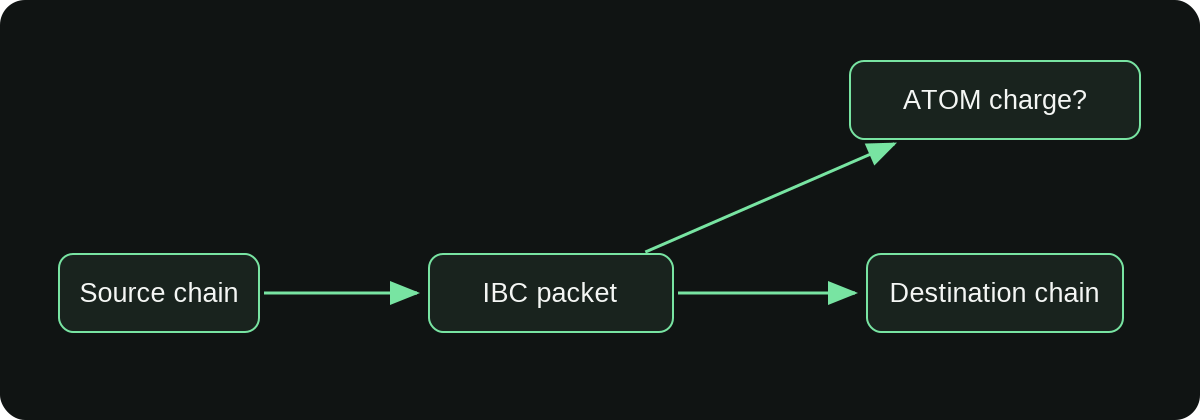
Follow one IBC transfer to the asset that pays
Inter-Blockchain Communication allows participating chains to exchange packets. A transfer between two chains involves routing and fees, and different parts of the operation can have different assets and payers. The useful question for ATOM is whether the path touches the Cosmos Hub and whether a fee or security commitment is denominated in ATOM. Count that attributable amount as its own observation. High activity on applications elsewhere is evidence of adoption of the wider stack. It can only support a direct ATOM valuation through a documented link. Cosmos IBC project documentation
The November Hub update mentions a concrete example worth examining, the dYdX shift of USDC backing and deposit routing toward Injective. The activity is meaningful to the applications and chains involved. To estimate the effect on ATOM, identify any settlement or service at the Hub and its payment mechanism. This discipline keeps the dollar amount of assets rerouted separate from revenue received by a chain or token holders. Cosmos Hub notes on the USDC routing change · USDC and usable redemption routes
Use the issuance assumption you can defend
| 2027 ATOM sensitivity | Change from $1.28 | At 565M circulating ATOM |
|---|---|---|
| $0.75 | −41% | $423.75 million |
| $1.60 | +25% | $904 million |
| $2.50 | +95% | $1.4125 billion |
The denominator is illustrative. If circulation reaches 600 million and the same $1.4125 billion valuation applies, the resulting price is about $2.35. The $0.75 stress case tests weaker liquidity while new supply enters circulation. The middle case allows incremental improvement in Hub activity. At $2.50, several periods of documented ATOM-denominated usage or security commitments would make the case easier to defend, especially if governance rules remain clear enough to estimate supply. CoinGecko Cosmos Hub market data
Keep a practical record of staking and capture
Staking figures are easiest to interpret when you know which quantity is circulating, how many tokens are committed and what changes the net issuance. To evaluate staking rewards, separate the amount that comes from issuance and the amount that comes from actual fees if the source makes the allocation visible. A nominal reward rate shows a change in your token balance before fees. The market price, operating terms and supply growth affect what that balance can buy or what it could earn on sale.
Gains in fees would be more informative if they are recurring. Compare several periods measured in ATOM, and note whether a migration, governance vote or unusual application created a temporary surge. If the same period saw major changes in price, quote the fee quantity in native units before making a dollar comparison. Use current validator terms and the applicable protocol parameters for a specific staking position. If a data provider aggregates revenue across unrelated chains or includes rewards with newly issued units, record that definition and keep it out of the direct-fee series.
For the next review, pick one tracked activity, write down which chain executes it and check the fee asset in equivalent transactions. Two independently corroborated observations under the same definition are a better pricing input than a large one-off transfer total.
If a proposal changes inflation, keep two further data fields. First, note the issuance rule and the date it starts to apply. Second, note whether a quoted yield includes independent fees or largely redistributes new issuance. Over a matched period, an increase in an individual's ATOM balance may accompany a similar increase in total supply. For a relative view, compare growth in token units with growth in supply. For a practical view, add any operator charges and check how long it would take to withdraw before estimating what could actually be realized.
The Hub also needs a useful definition of retained demand. A service that collects a fee once for a migration and a service that collects fees on normal recurring transactions should be tracked separately. For governance, preserve links with proposal numbers so the final outcome can be applied without relying on a copied timeline.
Frequently asked questions
Does an ATOM holder own a stake in every Cosmos application? ATOM is the Cosmos Hub's native asset. An independent application or chain can define its own governance, token rights and fee distribution.
Can an ATOM stake be converted into spot cash immediately? The answer depends on the route and the position. Native unbonding follows network rules, while a liquid staking representation can trade in its own market with a different price and liquidity.
Should I combine ATOM and staking receipt tokens in a market-cap total? Check the underlying collateral first. Adding the receipt's market value to the collateral as if both were independent positions can double count the same exposure.