 Coin Price Analysis
A Polygon recovery to $0.10 in 2027 would require a gain of about 29% from the November 23 UTC reference close of $0.077228. The recovery case gains credibility if payment integrations create repeated activity that uses POL and if fees and burns can be reconciled with issuance. The November 24 row had no completed close at the time of review. CoinGecko POL history
Check what your MATIC quote actually represents
Start with the asset on the network where your balance sits. Polygon PoS moved to POL as its native gas token in September 2024. Polygon’s support documentation says that native MATIC on PoS converted automatically at a one-to-one ratio. Its Portal offers a one-to-one migration for legacy Ethereum MATIC, which involves a transaction on Ethereum. An old wallet display can still say MATIC if its network settings keep the prior symbol. For an exchange balance, check the venue’s asset and network documentation before using its price or moving funds. Polygon’s migration announcement · Polygon Support’s migration guide
That difference affects chart research. A modern POL series is appropriate for valuing the current native token. A historical MATIC chart can provide context, but record the provider’s date and method for connecting the two. A conversion ratio says how many units replace the old ones. It does not establish that all historical quotes came from the same instruments, venues or liquidity conditions.
Follow the payment all the way to settlement
In October 2026, Polygon Labs announced that it had closed its acquisition of Coinme and named early Open Money Stack customers. That provides evidence of business capability and onboarding. It gives less information about which payment routes settle on Polygon PoS, what users pay in fees, or whether the volume repeats. An integration can move a customer from a bank into a stablecoin payment flow while the customer sees only dollars in the interface. Identify who sources the POL for gas and whether the chain actually records that step. Polygon Labs’ October 14 acquisition announcement
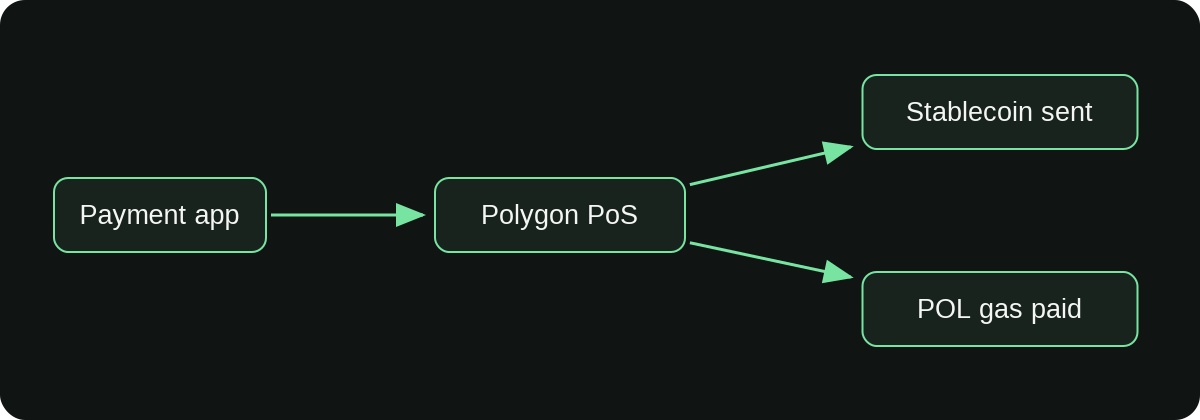
A useful measurement starts at the settlement chain. Record the period, the token sent, the fees paid and any evidence that the same users or payment providers returned. Stablecoin volume is often stated in dollars. POL gas is charged per transaction according to protocol rules. A large stablecoin transfer can carry a small POL fee, and a high-dollar-volume route can account for relatively few transactions. The relationship between dollars moved and demand for the fee token must be measured.
Reconcile POL issuance with burns
Polygon reported in October that the community completed a 100 million POL burn in September 2026 from base fees collected previously. The source and timing of the burn matter. If you compare quarters, avoid treating previously accumulated fees as though users paid all of them in the execution quarter. Otherwise a quarterly burn can inflate your estimate of current use. Polygon’s stablecoin volume and burn update
Maintain a small ledger with opening supply, gross new issuance, completed burns and closing supply. Keep a second line for changes in a data provider’s definition of circulation. Whenever amounts fail to reconcile, identify the missing category before describing POL as deflationary. To compare periods, preserve the same definition across both months. Gross burns can be measurable even when supply expands over the full period.
What different 2027 prices would imply
A rounded 10.65 billion POL input illustrates the scale of the following year-end cases. It approximates the supply scale at the time of writing. For a year-end market cap, replace the input with a dated circulating estimate. CoinGecko POL market data
| POL price | Change from $0.077228 | Implied value at 10.65B POL | What to investigate |
|---|---|---|---|
| $0.05 | −35% | $533 million | Settlement activity grows slowly, fees remain weak, or spot liquidity deteriorates. |
| $0.10 | +29% | $1.065 billion | Recurring payment activity shows up in PoS records and token economics improve. |
| $0.15 | +94% | $1.598 billion | Several payment routes produce sustained use, issuance and burn are reconciled, and trading depth improves. |
The prices are sensitivity points. They carry no probability and sit within a much wider range of possible outcomes. If you hold the implied market value constant, a larger future supply means a lower unit price. If payment activity grows while recurring fees stay flat, revisit the mechanism before raising your valuation. A network can improve its product even when the evidence for stronger token demand remains mixed.
At the next review, compare weeks with similar calendar conditions. Record the number of distinct settlement days as well as the total fee spend. A payment provider can have genuine recurring use even if its transfers are concentrated on business days. A single unusually large settlement is weaker evidence for baseline activity. Mark the concentration explicitly when it accounts for a substantial part of the result.
For a comparison with a different fee and governance model, see the Arbitrum 2027 outlook.
Frequently asked questions
Can I use a legacy MATIC order book for a POL exit estimate? Use an order book for the asset and network you can actually settle. A displayed price does not convey the withdrawal terms or the time and fees needed to switch routes.
Can I compare POL with its old MATIC peak using price alone? Include market value and circulation for both dates. Returning to the old unit price can require a different implied valuation after changes in supply.
Can I use fees paid on another Agglayer-connected chain as Polygon PoS fees? Identify the chain and fee recipient first. A relationship through shared infrastructure does not turn all its fees into Polygon PoS revenue.