 Coin Price Analysis
XMR would need to gain about 44% from its November 23, 2026 UTC close of $486.26 to reach $700. That level implies about $13.3 billion at a round 19 million XMR supply. Monero’s tail emission gives the supply model a starting point, while the 2027 price case also depends on liquidity that holders in a particular market can actually access. CoinGecko XMR price history · Monero’s technical specifications
What can be estimated from the protocol
Monero’s documents describe an ongoing subsidy of up to 0.6 XMR per block, with blocks targeting roughly two minutes. At that cadence and the full base subsidy, a simple annual calculation gives 0.6 × 720 × 365 = 157,680 XMR. Relative to a 19 million working denominator, it is about 0.83%. It is an illustrative estimate. Real block production and reward adjustments can change the result, and the supply input must be refreshed for a precise period calculation. Monero tail emission note · Monero technical specifications
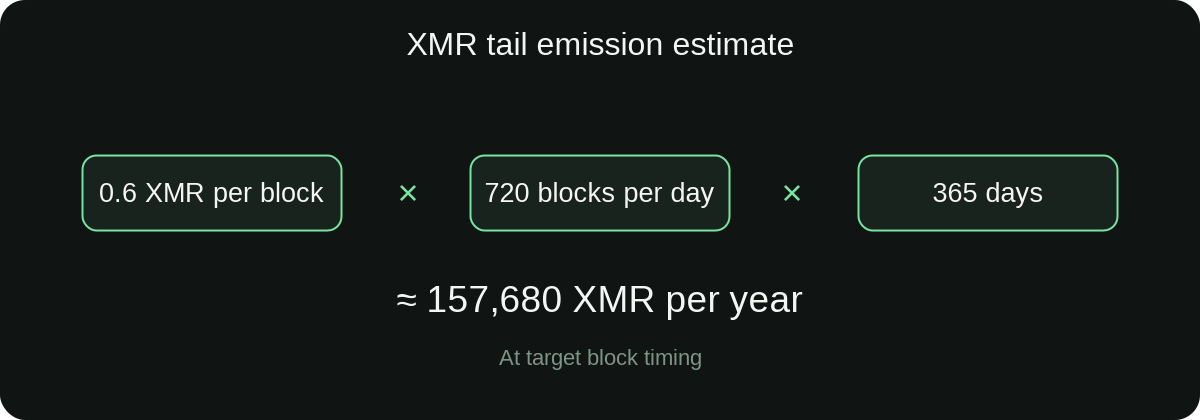
At a constant valuation, a larger number of coins implies a lower unit price. That supply effect is small relative to the difference between the $520 and $700 scenario points. To justify the larger move, investigate changes in demand and liquidity. The amount issued per block cannot establish when miners sell or how much available supply appears on a specific market. Reward figures and public execution records belong in separate series.
What the November development record supports
The official October 16 release described Monero 0.18.5.4 as a minor bug-fix release. The November 11 Monero Research Lab meeting listed a beta stressnet in its materials for Full-Chain Membership Proofs work. A released maintenance update and work on a testing network carry different implications for production usage. For a 2027 thesis, distinguish published research, software available for testing and an activated protocol change. Check a dated mainnet announcement before changing the classification. Monero October 16 release · November 11 Research Lab agenda
A technical improvement can matter to users while leaving open questions about its effect on price. Track completed development milestones alongside what you can independently measure about use. Where private transaction design limits the detail visible to a public observer, describe that limitation instead of treating transaction totals as evidence of the value moved or the number of different people using the network.
Compare exit depth in the markets you can reach
Kraken documented halting XMR trading and deposits for customers registered in the European Economic Area on October 31, 2024. That notice describes one venue and customer scope. It is useful historical evidence of how access can change without a change to issuance. Check current venue availability for the holder’s location, along with deposit and withdrawal support, before calculating proceeds. Kraken’s EEA Monero notice
| XMR 2027 sensitivity | Move from $486.26 | Implied value at 19M XMR |
|---|---|---|
| $320 | −34% | $6.08 billion |
| $520 | +7% | $9.88 billion |
| $700 | +44% | $13.30 billion |
The $320 case reflects weaker accessible liquidity or weaker demand. The $520 case is near the anchor and is compatible with mixed evidence. The $700 case needs a stronger valuation and enough accessible depth to sustain it. The levels illustrate arithmetic without assigning odds. For an order-size comparison, record the expected fill, quote currency and costs on two routes you can actually use. A large last trade on another platform is not an exit quote.
How to update the 2027 case when two signals disagree
Take two matched observations of accessible market depth and record the quote asset. A market can become more active without supporting the trade size you need, especially if the activity is concentrated on platforms unavailable to you. If the route pays out in a stablecoin, compare its conversion to dollars separately and note any delay. This keeps an exchange’s activity and the holder’s attainable value from being conflated.
Then put a protocol observation beside those trading records. Compare the level of progress across a software release, a testing milestone and activation. Record only the stage the project actually documented. A new release can increase confidence in continuing maintenance while leaving the probability of a particular protocol change open. Conversely, stronger spot quotes following a market-wide rally do not show that a release caused the rally. Keep a dated reason for each change in the outlook.
For an additional scale check, adding the illustrative 157,680 XMR to the 19 million supply input would increase it by less than 1%. At the same $9.88 billion valuation, the price would move from $520 to about $516 in that one-variable arithmetic. That difference is far smaller than the scenario spread. It explains why keeping the supply rule visible is useful while measuring accessible demand is still the larger task. The figures use constant valuation and target block timing as simplifying assumptions.
For an XMR-specific demand check, compare changes in executable quotes across markets with the move in a broader index over the same window. A relative gain can help identify a difference worth investigating. It cannot tell you whether access improved, a particular venue became shallow, or interest in the protocol changed.
Frequently asked questions
Does a constant XMR subsidy mean a constant inflation rate? The issuance amount can stay roughly stable while its percentage of the existing supply declines as that supply grows.
Does a venue delisting change Monero’s block reward? The venue’s policy affects access through that service. The subsidy follows the protocol’s rules.
Is a miner’s payout the same as the network subsidy figure? A realized payout can reflect pool terms, fees and timing. Use the protocol figure for issuance and the actual payout record for a miner’s income.