 Coin Price Analysis
At the November 23, 2026 UTC close of $0.393559, MNT would need to gain about 27% to reach $0.50. A better-supported recovery would pair wider access with repeated use of Mantle’s network and a clear picture of circulating supply. An exchange listing can give more people a route to trade. A real-world asset integration has a different effect, depending on the transactions it creates and who pays the gas. CoinGecko MNT history · Mantle’s network repository
A Japan listing changes access first
Mantle announced that MNT became available on Japan’s GMO Coin on November 18, 2026. Record the actual venue, instrument and any limits on settlement when evaluating the change. A new venue lets eligible customers transact through that route. It does not show how much incremental demand has appeared or whether liquidity moved from another venue. Assess the announcement through a venue-specific spot quote and dated evidence about trading depth after launch. Mantle’s November 18 listing announcement
To compare across markets, put quotes in the same currency using a matching timestamp. A yen price and a USDT price carry different conversion and settlement issues. Also distinguish a listing from a guaranteed execution price. Calculate proceeds after the estimated fill and conversion costs for the same number of tokens. Daily venue volume is context, but it cannot substitute for that calculation.
Follow real-world asset activity to the native fee
Mantle uses MNT as its native gas token. That connects transactions on the network to a specific cost. If an issuer brings a tokenized asset to Mantle, distinguish the amount outstanding from the activity that generates gas. A large issuance can sit in a few addresses and turn over rarely. Conversely, smaller payroll, payment or settlement flows can create repeated transactions. The announced value and the fees paid answer different questions. Mantle implementation repository · Mantle network specification
The Mantle Foundation website shows a “Real World Capital” measure that combines stablecoin and RWA market caps. Preserve that definition before comparing the headline with another platform’s TVL or network revenue. For a quarterly check, record outstanding assets and actual fee-paying settlement days separately. If a provider sponsors gas, see whether the burn or fee transfer, as applicable, is visible on-chain and who supplies the required MNT. Mantle Foundation metric definitions
Check the treasury before using a circulating estimate
Market value is calculated with a specific circulating number. The Mantle Treasury’s holdings can affect the outlook if governance authorizes distributions, budgets or incentives that put more tokens into use. An approved allocation is distinct from an executed transfer, and a transfer does not always enter the open market. Track the amount, recipient and any restriction. The governance record describes the decision. On-chain records describe what moved. Mantle Foundation treasury and governance · Kraken’s MNT asset disclosure
At 3.3 billion circulating MNT, a $0.50 price would imply $1.65 billion. With 4 billion circulating, the same price would imply $2 billion. The supply inputs are rounded comparison cases. The higher one is a stress test, rather than a statement about a scheduled release. CoinGecko MNT supply snapshot
| 2027 stress point | Change from $0.393559 | At 3.3B MNT | At 4B MNT |
|---|---|---|---|
| $0.25 | −36% | $825 million | $1.00 billion |
| $0.50 | +27% | $1.65 billion | $2.00 billion |
| $0.80 | +103% | $2.64 billion | $3.20 billion |
The $0.80 case is easier to justify if settlement activity recurs, native-fee use is visible and improved liquidity outlasts the debut of a new market. If listings expand while spreads stay wide and paid use remains flat, the evidence for a sustained repricing remains weak. The three levels are checks on valuation scale. None fixes the maximum or minimum future price.
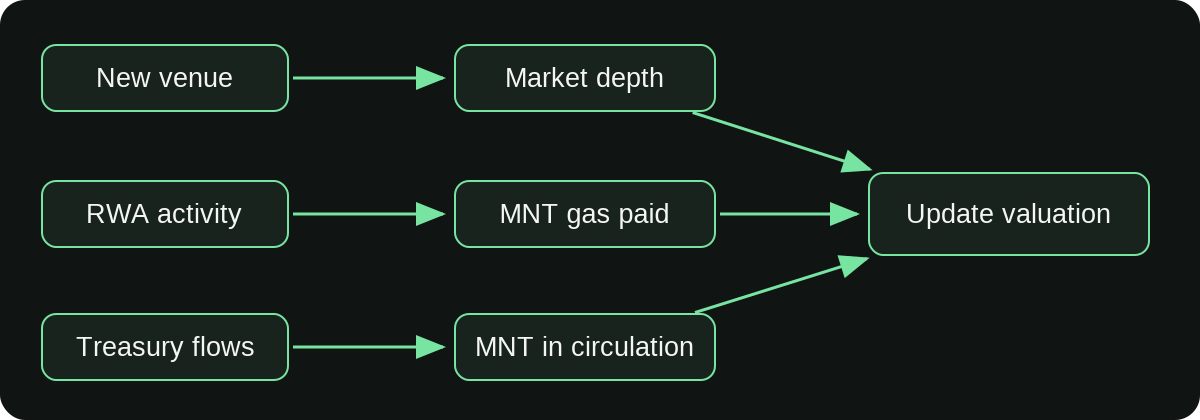
A practical way to revisit the listing is to track three separate series. First, record the size and quality of the market where the new listing was announced. Second, log the fee-paying activity in named applications over comparable windows. Third, reconcile treasury changes with circulation. A liquid new pair together with flat on-chain use can support an access improvement, while a higher network transaction count alongside wide spreads can tell a different story. Keep both observations when considering the price.
For real-world asset products, distinguish issuance, secondary transfers and redemptions. Issuance measures initial distribution. Secondary trading indicates activity among holders. Redemptions can be relevant to the user’s ability to access proceeds under the issuer’s terms. A single liquidity figure can hide all three. For an MNT forecast, compare how the amount spent on gas changes across these steps and use the actual fee measured for the period.
Finally, treat Mantle's treasury as an allocation question. A budget might be authorized in dollars, partly funded with stablecoins or spread across many months. Check the denomination, amount actually distributed and date of transfer before adding a projected MNT release to your 2027 supply estimate.
When comparing published market valuations, note whether a provider has excluded treasury balances or tokens backing another position. If the circulation number changes sharply, look for an actual transfer or a revision in the provider’s method before interpreting the difference as fresh coins reaching the market.
Frequently asked questions
Does holding MNT give me ownership of every stock-linked token on Mantle? A stock-linked product has its own terms and issuer. Holding the chain’s native token is a separate exposure.
Can dollar-valued RWA balances rise without any new tokens being issued? Yes. The underlying assets may change in value. Use units as well as dollars if the question is whether more assets were issued or used.
Can I value MNT and ARB from one gas-revenue formula? Their roles and fee arrangements differ. Check what users pay, what the protocol retains and the separate rights of token holders. Arbitrum’s fee and treasury outlook