 Coin Price Analysis
At the November 23, 2026 UTC close of $0.00529189, FLR would need to gain about 32% to reach $0.007. A stronger 2027 case would need evidence that XRP-based applications generate recurring network revenue and that verified supply reductions matter alongside new issuance. The amount of XRP deployed can establish demand for the applications. Fee routing determines whether any of it translates to FLR economics. CoinGecko FLR history · Flare’s FIP.16 proposal
Begin with a fee ledger instead of a TVL headline
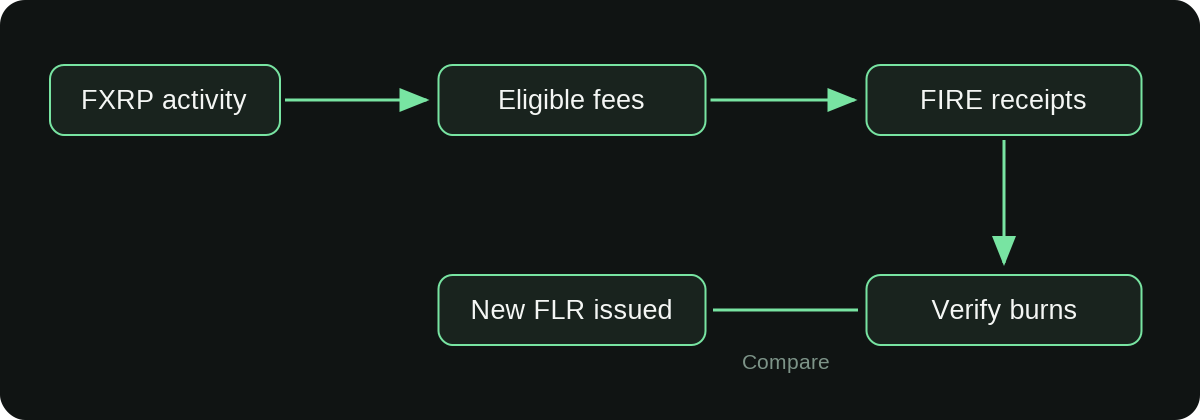
FXRP is an FAsset designed as a one-to-one representation of XRP on Flare. Its use in lending, trading or collateral products can generate different kinds of fees. Some belong to the application or its liquidity providers. Others may reach the network through explicit protocol rules. Choose one activity, identify the fee recipient and check whether the applicable rule sends some of it to Flare Income Reinvestment, or FIRE. The presence of FXRP in a contract does not by itself establish either fee collection or a burn. Flare FAssets overview · Flare’s one-year FXRP review
For example, Flare announced in October that Firelight’s protection layer was live, with its initial coverage applying to specified Sentora vaults. This supports a claim that a product reached a particular use case. A valuation model still needs the amounts exposed, fees collected and the destination of those fees. A fee paid to an application can support its business without implying a reduction in FLR supply. Flare’s October 6 Firelight announcement
A November 12 announcement said Flare had joined LayerZero as a decentralized verifier network and put mainnet availability in early December. For the November 24 cutoff, that timetable represents a planned launch. Treat actual issuer adoption and fees generated later as separate evidence. A number describing all assets or traffic using the broader token standard should not be attributed to this verifier. Flare’s November 12 LayerZero announcement
Check FIP.16 against the applicable reward period
Flare’s documentation says governance approved FIP.16 in April and describes a phased implementation. The target lowers the annual inflation rate from 5% to 3% and the annual ceiling from 5 billion to 3 billion FLR. The proposal also changes what balances count toward the base for inflation. If you compare two periods, note which rule was applied, the relevant base and the rewards actually issued. The ceiling and a headline percentage will not give the amount issued for a specific month on their own. Flare’s FLR technical reference · FIP.16 text and routing details
Keep a third line for accomplished supply reductions. A FIRE receipt is evidence of revenue routing. A documented buyback and a subsequent confirmed burn describe further stages. Track amounts in FLR and use the same period for issuance and burns. That makes it possible to state whether the token supply expanded even when the project collected fees or reduced the rate of growth.
Measure exposures in their original units when assessing adoption. A fixed quantity of XRP can contribute a higher dollar TVL after a price increase without a corresponding change in FXRP borrowed or minted. Record XRP or FXRP units at the beginning and end of a period, then measure the fees. A reported transfer of the same position between applications can also lift the total reported by a dashboard that counts at multiple levels. Start with net outstanding quantities and keep application figures separate.
Revisit the base case after a complete reward period. Enter active fee routes, the actually collected amount and the final destination. If a route is still awaiting issuer configuration, record it as available or planned according to the source. Give verified exits a separate line when the product involves redeeming FXRP. Simply observing bridge inflows can miss whether users can leave comfortably in volatile conditions.
The three price levels come with different hurdles
Using 85 billion FLR as a rounded calculation input near the late-November circulation scale, the three levels have very different implied values. Circulation at the end of 2027 will depend on releases and the token’s actual supply rules. CoinGecko FLR market data
| FLR year-end sensitivity | From $0.00529189 | Implied value at 85B FLR |
|---|---|---|
| $0.003 | −43% | $255 million |
| $0.007 | +32% | $595 million |
| $0.012 | +127% | $1.02 billion |
The $0.007 case tests a recovery in which adoption persists and FLR-specific fee activity becomes easier to verify. A stronger move toward $0.012 would call for evidence across several periods and enough depth to support actual trades near the higher level. The downside case covers weak market access, slower paid use or issuance that continues to outweigh reductions. These points give the reader ways to review the thesis without assuming hard boundaries for the market.
One helpful stress test is to hold realized fee revenue constant while changing the amount issued. This makes it easier to understand the potential effect of a protocol rule in a quiet market. Then hold issuance constant and change observed burns based on documented fee routes. The second test shows how much growth in paid activity would be needed to arrive at the same supply result.
Frequently asked questions
If XRP rises, should FLR rise by the same percentage? FLR trades separately. XRP’s price can raise the dollar value of a fixed FXRP balance without increasing the number of tokens deployed, transactions made or fees paid.
Can an FXRP holding on another chain be counted as new XRP locked on Flare? A cross-chain move can represent the same underlying exposure. Reconcile the route and look at aggregate outstanding balances before adding both sides.
What role can a delegate’s reward history play in a price model? It helps document historical token payments under the applicable rules. Future staking or delegation terms and spot liquidity should each be evaluated separately.