 Coin Price Analysis
ETC would need to gain about 103% from its November 23, 2026 UTC close of $5.90 to reach $12. With an illustrative 155 million circulating ETC, that price would imply about $1.86 billion in market value. The July reward cut changed issuance and subsidy income. The 2027 price case depends on how much demand remains and whether the network’s usage and miner economics support it. CoinGecko ETC price history · ETC’s monetary policy
What the July reward cut actually did
The ETC community call and referenced block record place the July 22, 2026 reduction at block 25,000,001. The base subsidy fell from 2.048 to 1.6384 ETC, a 20% decrease under ECIP-1017. The rule uses block height, so dates for later reductions depend on how quickly blocks are produced. A mining model can use the lower per-block reward immediately after the observed activation. A calendar forecast for a later era requires a separate assumption about the block rate. Ethereum Classic community call and block record · ECIP-1017
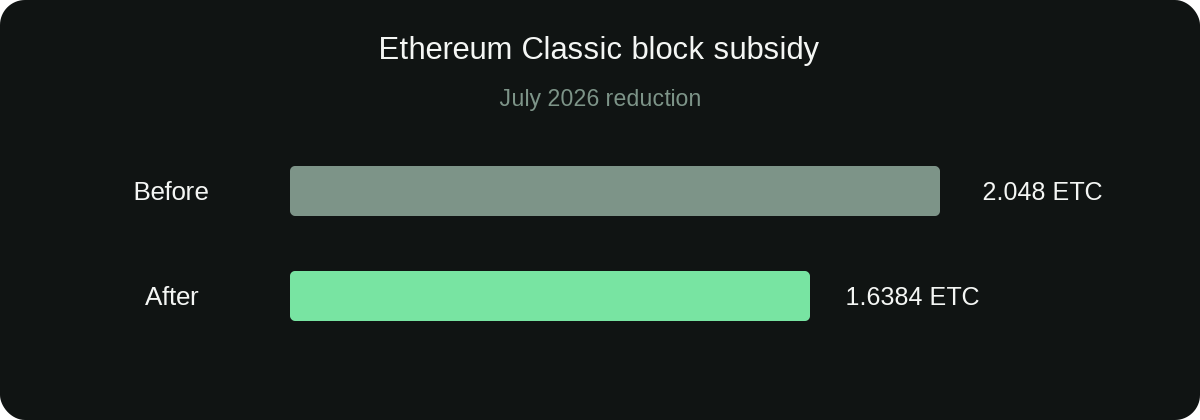
At the same $5.90 token price, the old subsidy would be worth about $12.08 per block and the newer subsidy about $9.67, before fees or any other components. It would take about $7.375 per ETC for the new subsidy to match the old dollar amount under this illustration. The calculation is a miner-revenue sensitivity. It does not give a price floor or indicate that a market will adjust until miners earn the same dollars.
Separate miner security economics from the Olympia roadmap
For a network snapshot, compare fees earned by miners, the applicable subsidy and the time period. Price changes can lift the dollar value of rewards while the protocol still issues the same number of ETC per block. Also check hash-rate trends alongside mining arrangements and liquidity before interpreting a change as a specific safety outcome. If you need actual settlement, verify the venue’s current confirmation requirement. Different venues can apply different thresholds.
Olympia’s upgrade page targets mainnet activation in 2027, with the activation blocks for Mordor and mainnet still listed as to be determined in the material reviewed. That is a target and a coordination plan. Compare a published specification, the testnet activation and a confirmed mainnet height separately before adding network changes to your valuation model. Technical changes in Ethereum do not automatically activate on Ethereum Classic. Olympia upgrade status · Ethereum’s separate roadmap and price analysis
How to read $3.75, $7.50 and $12
| ETC year-end sensitivity | From $5.90 | Implied value at 155M ETC |
|---|---|---|
| $3.75 | −36% | $581.25 million |
| $7.50 | +27% | $1.1625 billion |
| $12.00 | +103% | $1.86 billion |
$3.75 tests weak demand or thin spot depth. The middle case allows for a moderate market recovery. $12 calls for sustained demand which may be easier to support if upgrade milestones, useful application activity and executable spot depth advance together. This table shows what each price means at one supply input. Update the input from a dated supply estimate and keep block-based issuance distinct from the size of the orders actually available. CoinGecko ETC market data
A useful follow-up is to compare network fee activity over similar periods and demand across ETC and another market benchmark. A one-day equity or crypto rally can change the token’s dollar price without a comparable change in application use. Similarly, a new application can raise transactions without making the price levels shown here more probable if costs are subsidized or quickly fall. Use the adoption evidence and the price observation as separate tests.
Test the fee contribution with a matched set of blocks
To compare miner income before and after the July change, obtain a representative set of blocks on each side. Record the base subsidy per block and any transaction fees received under the applicable rules. Compare those in ETC first. Then, if needed, translate them into dollars using the same convention for both periods. A rise in dollar-denominated income can come from a stronger token price without any change in the token amount paid by users.
If a proposed upgrade changes fee routing, write down who would receive each charge and what stage the proposal has reached. A discussion of possible funding for protocol development describes a potential policy. It does not establish what is ultimately routed to miners, a treasury or elsewhere. A post-activation check should use the active rules and compare those allocations over multiple windows before making a claim about the resulting valuation. Olympia governance and treasury description
Finally, keep network measurements distinct from a holder’s operational requirements. A confirmation rule on one exchange can lengthen the time a deposit remains unusable relative to another platform. If settlement speed matters, compare what the service applies to the specific token and network. A recent period of stable block production does not guarantee a particular service’s crediting time. Record the price when funds can actually trade for a useful comparison of the withdrawal or sale route.
Compare the same block-level figures using multiple periods so a few unusually costly transactions do not dominate the conclusion. Include the range observed in the window if possible. That gives a more useful estimate of typical fee contribution than an isolated peak block.
Frequently asked questions
Can I use an ETH chart as a reference price for ETC? They are separate assets. A relative return may add context, but use comparable ETC quotes to assess an ETC position.
Does the date of a client release establish a fork date? Client code can be published ahead of activation. Check the announced network and confirmed block height independently.
Do we know that miners sell all newly issued ETC each day? Issuance records show new coins created. Estimating sales requires separate evidence of transfers or executed trades.