 Coin Price Analysis
CC would need to rise about 91% from its November 23, 2026 UTC close of $0.078601 to reach $0.15. The November 24 CoinGecko snapshot was approximately $0.07985. The more useful test is whether real Canton settlement generates recurring fees that use CC and whether the growth in that use can keep pace with newly minted units. CoinGecko Canton historical data · Canton network economics white paper
A large pool of eligible collateral is a starting point
Canton's November 12 project update highlighted DTCC's October 28 milestone and described a large pool of high-quality assets available for tokenization or onchain use. A pool made available sets the scope of a service. It does not disclose how much has been tokenized, how often it moved or how much CC an operator needed for those flows. Where a custody, collateral or settlement institution gives an operating update, look for a transaction amount and a period of use. Canton's November 12 update
A concrete example of the narrower evidence is a Société Générale disclosure describing a completed transaction using tokenized U.S. Treasury collateral on Canton. That confirms a specific use case at the scope stated by the institution. For a forecast, check for additional transactions under similar conditions and evidence of settlement charges. A recent case can make a service easier to understand without establishing monthly volume or operator demand across Canton. Société Générale transaction announcement
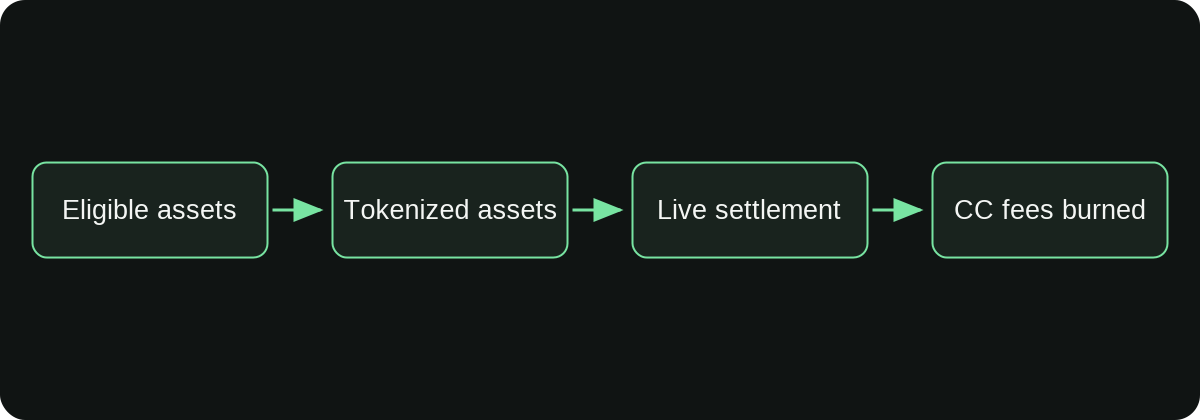
Log what is burned and what is minted
Canton's Global Synchronizer uses Canton Coin in its fee and incentive mechanics. Consult the network's descriptions of fees and rewards, then record amounts burned and newly minted for matching reporting windows. CC supply can grow even when fees burn tokens. The subtraction is informative only when both amounts cover the same system and period. Keep figures denominated in CC, with a separate column for currency conversions used in a report. Canton Global Synchronizer · Canton Coin MiCA white paper
Also distinguish a change in application rewards from changes in activity. A high reward can encourage operators even when fee-paying behavior is early. If the same activity creates revenue and qualifies for rewards, identify the quantities attributed to each. A protocol-level net supply figure can remain meaningful while the behavior of individual applications is difficult to observe because Canton supports selectively shared data.
What $0.15 would imply
At 45 billion illustrative circulating CC, $0.045 implies $2.025 billion and a decline of about 43% from the close. It tests weaker settlement usage, continued net expansion or a shallow spot market. $0.09 implies $4.05 billion and a gain of about 15%. It allows growing adoption while issuance and fee burns are still being reconciled. $0.15 implies $6.75 billion and a gain of approximately 91%. It would take more verified activity and the liquidity to support a materially higher market valuation. CoinGecko CC market and supply data
The arithmetic changes if circulation is closer to 50 billion at the time. With $6.75 billion of market value, the implied price is then $0.135. This sensitivity puts a testable denominator under a commonly requested target. Keep it updated from the same data provider and record its treatment of rewarded balances or any other categories that make circulation estimates diverge.
Build a settlement record without overstating the data
For each deployment you follow, capture whether it is a pilot, a live single transaction or an ongoing workflow. Add a dated range or exact volume only when the institution provides one. For CC demand, check whether the service used the Global Synchronizer, who paid the charge and whether amounts are described as gross or net. If private information prevents attribution, document the evidence as a verified service milestone and leave the valuation input unspecified.
The same method works for comparing headlines across networks. Asset value in custody, assets eligible for a service, collateral posted and fees paid answer different questions. A comparison that uses the same category on both sides makes it easier to evaluate where traction actually increased. Before interpreting a thin market quote, also record whether the spot venue can support the position size and transfer route of interest. Chainlink's tokenization and service evidence discussion
Follow the coverage of each reported amount
Suppose one disclosure identifies a pool as eligible for onchain use and a subsequent disclosure identifies a live collateral transaction. They describe stages of the same opportunity, so avoid summing them into one adoption amount. An evidence record might carry one entry for eligible value, another for outstanding tokenized assets and a third for period settlement turnover. A fee figure carries its own denominator, such as chargeable traffic or particular service usage. The result is a record you can update even when an institution shares only part of its operating data.
Also distinguish a reward distributed to help an operator participate from a recurring fee the operator must fund. Both can be described in CC. A system can show strong interest at the reward stage while user-funded payments are still emerging. Reconcile the two in token units and then refer back to the published issuance rules before assuming net supply growth has slowed.
Lastly, test the buyer's view of the market independently. Compare actual bids for at least two sizes at equivalent times. Note whether quotes can settle to the relevant currency and whether transfers into that venue are supported. A rising market capitalization at the midpoint does not tell you how many dollars can execute there. That difference matters when a token's thin markets react sharply to news about a particular institutional pilot or application.
Frequently asked questions
Does owning CC give me ownership of tokenized U.S. Treasuries? Rights depend on the specific Treasury product and its documentation. CC exposes its holder to the coin, which serves a separate network role.
Can a private transaction still produce public reporting? Participants can publish a dated case study or aggregated operational figures without exposing all transaction details. Use its disclosed scope when interpreting the figures.
What is the difference between an operator reward and a market purchase? Rewards are allocated under network rules. A market purchase is an exchange transaction and needs a separate record of acquisition and execution.