 Coin Price Analysis
BSV would need to gain about 83% from its November 23, 2026 UTC close of $14.18 to reach $26. CoinGecko showed an interim November 24 quote of $14.14. Useful evidence for the higher case would include sustained fee-paying application demand and better executable liquidity. The Teranode scaling work offers a technical case to investigate, with a separate test for how much of its capacity users actually need. CoinGecko Bitcoin SV historical data · Teranode project
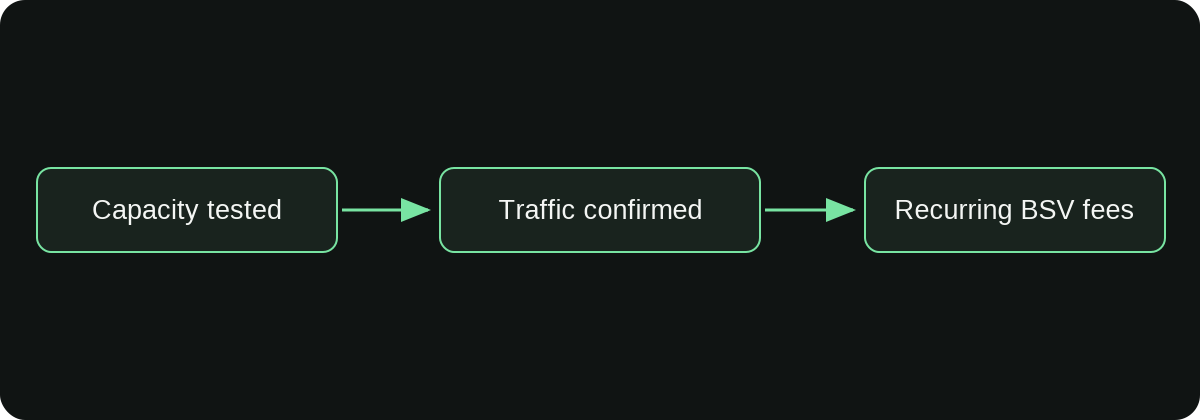
Separate throughput under test from production fees
The Teranode project describes software intended to process large workloads. For a 2027 valuation, investigate one workload all the way from test to production. Record the environment, duration, load profile and what the operators actually measured. For example, a BSV Association case study reports more than one million transactions per second in work involving Aerospike. Record that number as a project-reported technology result and seek separate evidence of normal mainnet fee demand. BSV Association Teranode case study
A measured rate under reported workload conditions provides useful engineering evidence. To link it to BSV demand, look for transactions confirmed under ordinary operating conditions and fees paid by customers or applications with a recurring reason to use the chain. Teranode project and deployment updates
One application might submit a large number of inexpensive operations from a single funded wallet. That pattern can make the network busy even when the amount of BSV required by the customer is modest. Where the data allow, compare paid operations, repeat workloads and fee expenditure in BSV. Keep subsidies in a separate column. If one customer supplies much of the volume, record concentration before extrapolating that customer's usage across the network.
Check which side of the trade a headline quote represents
BSV, BTC and BCH are distinct assets. Compare the BSV spot book using the trading pair and network actually supported by the venue. An aggregate quote can be a useful reference while omitting constraints of a given account, or the difference between a thin offer and the price at which a reader can sell. Use a common quote asset and take snapshots for the same order size. A spot withdrawal restriction can matter to valuation because it can make the apparent gap between venues difficult to trade. Bitcoin Cash and its separate market
For a liquidity check, record the best bid and estimated average bid for your amount. Measure the difference as a share of the best bid. Next record deposit and withdrawal availability at the same time, along with the venue's fee and the cost of converting its proceeds if needed. Repeat once in an ordinary market and once during a more active session. This gives you evidence about the size of the price that can be realized rather than assuming the quoted change is available to every seller.
Size the price case against circulating supply
| 2027 BSV price test | Change from $14.18 | Implied value at 20.2M BSV |
|---|---|---|
| $8.00 | −44% | $161.6 million |
| $16.00 | +13% | $323.2 million |
| $26.00 | +83% | $525.2 million |
The 20.2 million basis is illustrative. At the same $525.2 million valuation with 20.5 million circulating units, the implied price falls to about $25.62. The $8 stress case allows weak application demand or fewer accessible spot routes. The $16 case allows incremental production use and ordinary depth. The $26 case would benefit from several comparable periods of higher fee-paying use and wider liquidity. A rally without those changes could still happen, with a less durable usage-based explanation. CoinGecko BSV market and supply reference
A capacity claim is easiest to test with a normal workload
Compare the same class of activity under a known set of conditions before collecting the largest numbers you can find. Record whether the sender submitted the operations, whether they were accepted into blocks and whether those blocks remained in the observed chain. Also note how the original source measured throughput and whether the announced results describe one node, several nodes or a network deployment. Differences in definitions can easily make two genuine numbers unsuitable for comparison.
Then compare fee receipts with issued mining rewards if the source provides both. A rise in transaction count may matter to the system while leaving mining income dominated by the subsidy. A rise in the amount of BSV spent on useful applications provides separate evidence. Where fees cannot be attributed by application, state that limit and avoid assigning the full network increase to an announced customer.
The evidence that would change the outlook
Watch whether fees rise in native BSV across comparable months. Then compare changes in the number of identifiable applications, exposure to one large sender, and the concentration of venue volume. Many variables can move together during a broad crypto rally. Comparing BSV with BTC over the same dates adds a relative pricing check without treating a correlation as the reason for the move. Save the observation windows and the market pair used for both series. Bitcoin 2027 benchmark discussion
If a data source counts raw transactions while another counts transfers or outputs, keep the series separate. Use the measure closest to the intended task. For example, measuring demand from a paying application requires a way to link fees to that application. Measuring network utilization may need a broader distribution of transactions. A data gap deserves a note beside the scenario rather than a guess about which application caused a change.
For a payment route, also distinguish block inclusion from when a receiving venue credits funds to the user. That operational gap may change the execution price even if network conditions remain steady. A price view based on an active market and a reliable transfer path is more informative for an actual holder than a composite price alone.
Frequently asked questions
Does my BTC balance include any BSV from the split? Current wallet balances are chain-specific. Any claim tied to historic holdings depends on when and where they were held and on the service's historical fork policy.
Should I compare average or median BSV fees across periods? Report both if the data allow. The median shows the middle transaction, while a higher average can signal a small number of unusually costly operations.
Can a BSV derivatives chart substitute for spot history? A derivative can trade at a premium or discount and can have funding or expiry rules. Use spot history when estimating a cash sale.