 Coin Price Analysis
ALGO would need to rise about 97% from its November 23, 2026 UTC close of $0.081404 to reach $0.16. At 9 billion circulating tokens the price would imply about $1.44 billion of market value. The 2027 case depends on whether ongoing usage and token demand improve while Algorand continues funding consensus incentives. CoinGecko ALGO price history · Algorand November 6 community update
The announced plan extends consensus rewards into 2028
In its November 6 community update, the Algorand Foundation said it had committed to extending staking rewards through January 2028. The same update took several previously discussed ideas off the table for the time being, including increasing the ALGO supply cap, introducing and capturing MEV, and increasing the minimum transaction fee. Treat the commitment as evidence about the incentive plan. A valuation model still needs to check the funding source and how much demand comes from use of the network itself. Algorand’s community update
Algorand’s FAQ describes a reward made up of a share of block fees and a supplemental Foundation-funded bonus. An August report gives a useful starting scale: roughly 6.74 million ALGO paid to validators that month, with approximately 2.02 billion ALGO online in consensus. Those figures ask different questions. The first is a period payment. The second describes participation at the published scope. A higher balance in consensus can help demonstrate that incentives attracted stake, while keeping future fee coverage as a separate question. Algorand rewards FAQ · August 2026 Algo Insights report
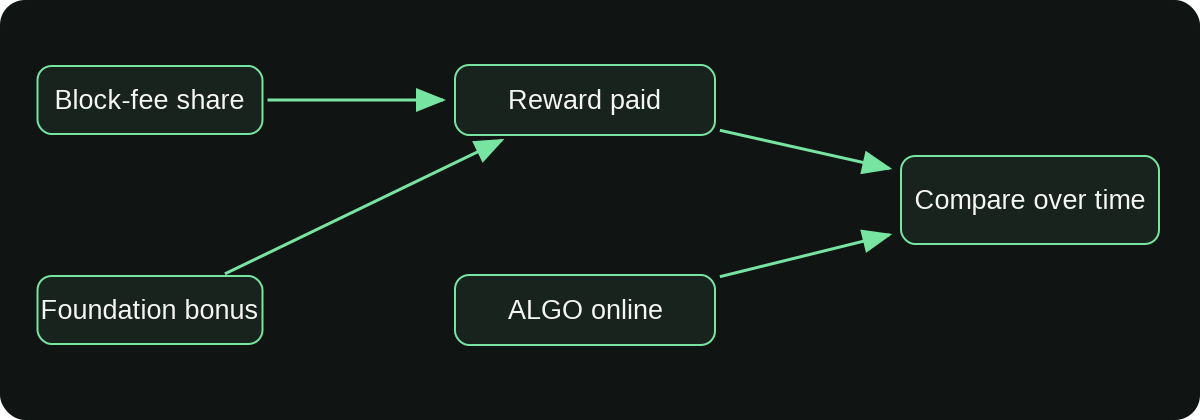
Evaluate whether fees and recurring use are catching up
To update the price case after a quarter, write down the total transaction fees, the portion that applies to block rewards and the separate supplementary amount. Use ALGO-denominated figures before translating them into dollars. A token price rally can raise translated dollar fees even if users collectively paid the same number of ALGO. Compare matched periods and document any changes in the fee rules. This lets you test whether rewards are increasingly supported by usage or still rely heavily on supplemental funding. Algorand protocol reward specifications
Use an application cohort to check the demand side. If a launch brings many transactions, ask who paid the fees and how many customers or merchants return. If a single operator sponsors fees for everyone, user counts need not translate into the same number of new ALGO buyers. Verify repeat fee-paying activity beyond the campaign window before interpreting a cumulative count as sustainable demand. The amount of stablecoins held or moved on the chain should be recorded under its own definition so deposit balances do not substitute for actual ALGO expenditure.
What the price levels imply
| ALGO 2027 sensitivity | From $0.081404 | Implied value at 9B ALGO |
|---|---|---|
| $0.05 | −39% | $450 million |
| $0.10 | +23% | $900 million |
| $0.16 | +97% | $1.44 billion |
The 9 billion input is a rounded circulation assumption. An October Kraken disclosure cited about 9.07 billion circulating and a total supply of 10 billion. Circulation will need a fresh measurement when revisiting the case. The low case reflects weak network economics or market liquidity. The middle case fits a modest recovery while fee evidence remains mixed. The $0.16 case asks whether several independently measured uses can support a roughly doubled price. These illustrative levels do not bound the market. Kraken ALGO crypto-asset disclosure
A practical comparison might hold valuation fixed while changing circulation, then hold circulation fixed and change the assumed valuation. The first reveals the arithmetic effect of supply. The second shows how much stronger the market valuation must be. To judge whether a recovery is durable, check both repeat network use and prices at which actual sellers can transact after the initial move.
Use participation and circulation as separate measures
The August report also showed approximately 9.04 billion ALGO in circulation at month-end. Comparing that number with online stake can be useful for tracking which portion of the outstanding token base participates in consensus. It should be done within comparable measurement windows and using the report’s definitions. An increase in circulating units can accompany an increase in online stake. The two changes can have different effects on liquidity because participating tokens and the balance immediately offered on venues answer different questions. August Algorand activity report
For a stress test, hold the observed online balance fixed and vary the amount of fee-paying activity. If network fees do not grow, the share of rewards funded by users can remain small even while participation is strong. Then reverse the test and keep fees fixed while participation changes. The resulting evidence can support an assessment of security participation without showing stronger token demand at exchanges.
Track who participates across the duration of the announced rewards plan. If a group enters around an incentive change, compare conditions before and after that increase, including the share of stake from the Foundation and the community where published. A raw rise in online stake can be driven by different groups. Compare it with recurring fee-paying activity, withdrawals and accessible spot depth. This helps determine whether the 2027 price case depends primarily on incentives or whether existing users also create new demand.
Frequently asked questions
Does the extension through January 2028 set a fixed reward for each ALGO holder? The announcement addresses continuation of a program. Actual eligibility and payout depend on the participating arrangement and its terms.
Does more ALGO online in consensus mean those tokens were burned? A consensus balance describes participation. It does not establish a permanent supply reduction.
Can a USD-denominated chart show an ALGO recovery while ALGO underperforms another asset? Yes. Compare the two assets at the same times and calculate the relative return separately.